
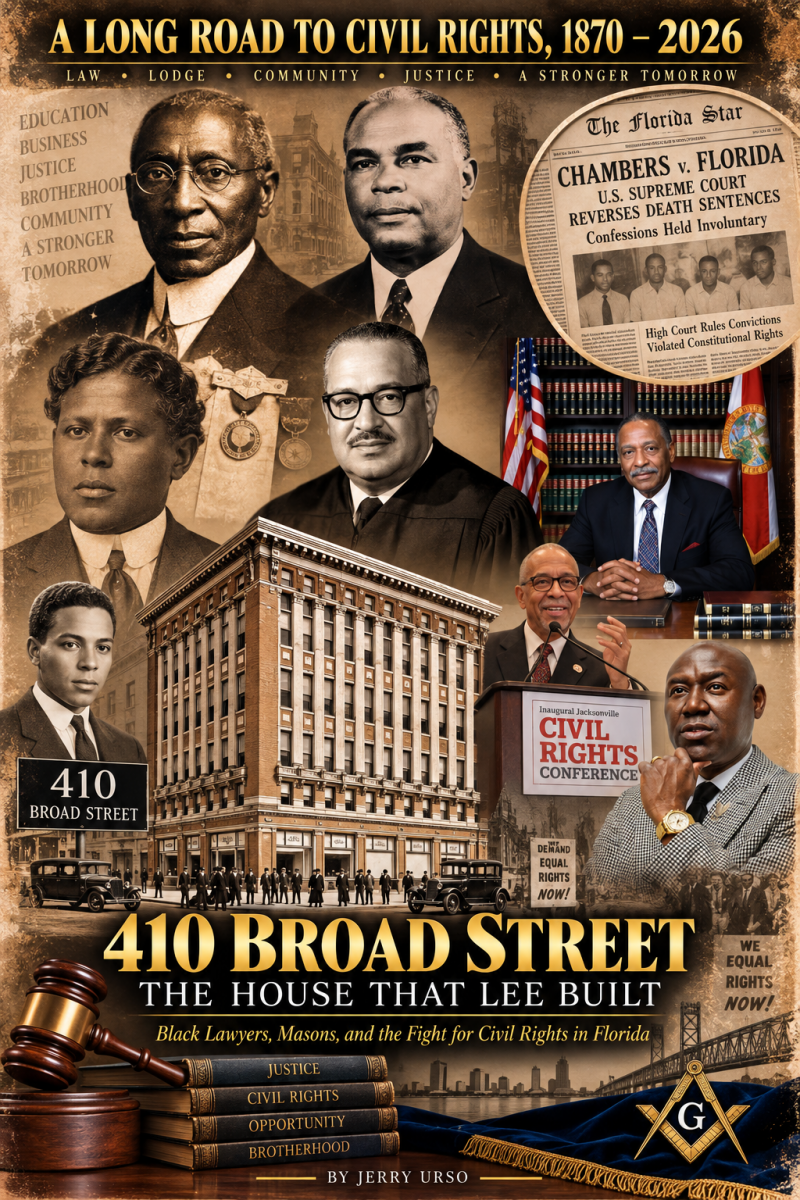
410 Broad Street
The Heartbeat of Florida’s Long Fight for Civil Rights
The House That Lee Built
By Jerry Urso
The House Before the House
The story of the Masonic Temple at 410 Broad Street does not begin with bricks, mortar, or the completion of the great six-story building in 1916. It begins with men. Long before the Temple rose above Broad Street, members of the Most Worshipful Union Grand Lodge of Florida, Prince Hall Affiliated, were already fighting some of the battles that would define the Black freedom struggle in Florida.
They were lawyers, judges, legislators, ministers, educators, businessmen, and political organizers. They entered courtrooms in which Black defendants could not expect equal justice. They sought and held public office while white political leaders were working to destroy Black voting power. They defended Black institutions, challenged discriminatory laws, fought for education, and used Prince Hall Masonry as a statewide network for leadership and community advancement.
That distinction is essential to understanding 410 Broad Street. The Temple did not create this tradition. The tradition created the Temple.
By the time the building was completed in 1916, the Grand Lodge already possessed generations of legal and political leadership. Joseph E. Lee, William F. Thompson, John Wallace, Judge James Dean, J. Douglas Wetmore and others had demonstrated that the fraternity could produce and sustain men capable of confronting the legal and political machinery of their time. Later generations would carry that tradition into segregation cases, voting rights battles, equal pay litigation, labor organizing, NAACP activism, the Jacksonville sit-ins, Ax Handle Saturday, and eventually the highest courts in Florida.
The building gave that tradition something segregation made especially important: permanent Black-controlled space. Its offices, businesses, lodge rooms, the Grand East, and Dickerson Hall existed within an institution controlled by Black men at a time when almost every important avenue of public life was restricted by race. Lawyers could practice, businessmen could conduct commerce, organizations could meet, Masons could deliberate, and community leaders could organize.
That is why the history of 410 Broad Street must begin before 1916.
It begins with the generation that built the foundation.
Joseph E. Lee: The House That Lee Built
Joseph E. Lee stands at the beginning of this story because his life brought together nearly every institution that would eventually make 410 Broad Street important: law, elected government, the judiciary, education, religion, Republican politics, and Prince Hall Masonry.
Educated at Howard University, Lee came to Jacksonville in 1873 and established himself as the city's first Black attorney. His career quickly moved beyond private legal practice. He was elected to the Florida House of Representatives, later served in the Florida Senate, participated in Republican Party politics at the state and national levels, and held important federal positions, including Collector of Customs and Collector of Internal Revenue.
But one event in 1888 places Lee in a particularly important position in the history we are telling.
Joseph E. Lee became the first Black elected judge in the South.
On April 3, 1888, Jacksonville voters elected Lee Municipal Judge over two white opponents. At the very moment when the political achievements of Reconstruction were being stripped away across the South, a Black attorney in Jacksonville went before the electorate and won the authority to sit in judgment from the bench.
That victory was larger than Lee.
It demonstrated that Black political organization, voting strength, professional preparation, and institutional leadership could translate into governmental power. A Black man was not simply appearing before the court as a defendant or lawyer. He was sitting on the bench administering the law.
One of the people who witnessed that authority was a young James Weldon Johnson. Johnson later remembered that his father took him to court to see Joseph E. Lee sitting as judge. That image, a Black man occupying the bench in a Southern courtroom, became part of Johnson's formative experience. Johnson himself would become a lawyer and eventually one of the most important national civil-rights leaders of the twentieth century.
Lee's leadership extended directly into Prince Hall Masonry. A member of Harmony Lodge No. 1, he served the Most Worshipful Union Grand Lodge of Florida as Grand Legal Advisor and Grand Secretary. In those positions, Lee brought his legal knowledge and political experience into the institutional life of the Grand Lodge. The fraternity was therefore developing its own legal infrastructure decades before the present Temple opened.
Lee also lived long enough to witness what that institution became.
When the Masonic Temple at 410 Broad Street was completed in 1916, Joseph E. Lee was still alive. He had spent decades helping build the legal, political, and Masonic foundation upon which it stood. He died on March 25, 1920, after the Temple had already become the physical home of the institution he had helped strengthen.
That gives the phrase “The House That Lee Built” a deeper meaning.
Lee did not have to lay its bricks to help build the house. He helped construct the institution behind those bricks. He helped establish the tradition of lawyers and public officials within Florida Prince Hall Masonry, and unlike many pioneers whose institutions were built only after their deaths, Joseph E. Lee lived to see the house standing.
William F. Thompson: Holding Political Ground
While Joseph E. Lee was building Black legal and political power in Jacksonville, William F. Thompson represented the statewide character of the same struggle.
Born in Thomas County, Georgia, in 1852 and later establishing himself in Tallahassee, Thompson became a lawyer, educator, legislator, justice of the peace, tax assessor, and teacher of law. His career demonstrates how broad the first generation of Black professional leadership had become following emancipation.
Thompson was appointed Justice of the Peace for Leon County in 1872, serving until 1873 and returning to that position in 1874. In 1877 he was elected to the Florida House of Representatives from Leon County. He later served as Tallahassee city tax assessor in 1884 and again in 1887.
These positions mattered. Black men were not merely demanding that government recognize their citizenship. Men such as Thompson were actually exercising governmental authority, interpreting laws, collecting public revenue, representing constituents, and participating directly in the operation of the state.
Then came 1885.
Thompson was elected as a delegate from Leon County to the Florida Constitutional Convention of 1885, placing him inside one of the most consequential political gatherings in Florida's post-Reconstruction history.
The circumstances were vastly different from those of the 1868 Constitutional Convention. Reconstruction had ended. White Democrats had regained political control, and the political environment was moving steadily toward disfranchisement and legally enforced segregation. Thompson and the small number of Black delegates entered a convention in which they were badly outnumbered.
Education became one of the difficult battlegrounds. Thompson supported the public education article establishing segregated schools while attempting to preserve public funding for the education of Black children. His signature appears on the Constitution adopted on August 3, 1885. The compromise reflected the increasingly restricted political world in which Black leaders were being forced to operate. They were no longer negotiating from the political strength briefly made possible by Reconstruction. They were trying to preserve pieces of that promise while much of it was being dismantled around them.
Thompson was also part of the Prince Hall Masonic network. He was a member of Mount Olive Lodge No. 5 in Tallahassee, under the Most Worshipful Union Grand Lodge of Florida.
That fact is important to the story of 410 Broad Street because Thompson does not need to have practiced law inside the later Jacksonville Temple to belong to its history. The Grand Lodge was a statewide institution. Long before 410 Broad Street existed, its lodges connected Black men who were lawyers, lawmakers, judges, educators, ministers, and civic leaders throughout Florida.
Thompson represents that larger network.
Lee exercised political and judicial power in Jacksonville. Thompson exercised legal and governmental authority in Tallahassee. Both belonged to the Prince Hall Masonic tradition that eventually established its great headquarters at 410 Broad Street.
And in the same year that Lee made history on the Jacksonville bench, another Black lawyer connected to this emerging tradition would win election to the judiciary.
His name was James Dean.
Dean's election would be historic.
What happened to him afterward would demonstrate just how determined Florida was to take Black judicial power back.
John Wallace: From the Battlefield to the Courtroom
John Wallace belonged to the generation that experienced freedom not as an abstract promise but as something that had to be fought for, defended, and then transformed into political power.
Born enslaved in North Carolina around 1842 and brought to Florida, Wallace enlisted in the Union Army on August 15, 1863, serving with the 2nd United States Colored Infantry. His military service included operations in Florida and the Battle of Natural Bridge. He was mustered out in January 1866, but his struggle for Black citizenship was only beginning.
Wallace became a page at the Florida Constitutional Convention of 1868, witnessing firsthand the attempt to reconstruct Florida's government after slavery. He later entered politics himself, winning election to the Florida Legislature and serving terms in both the House and Senate. His political career placed him among the Black officeholders who attempted to turn emancipation into lasting political power.
By the late 1880s and 1890s, Wallace had also established himself as one of Florida's pioneering Black attorneys. His practice is especially important because it demonstrates that Black civil rights law in Florida did not suddenly appear in the twentieth century. Wallace was already entering courtrooms and demanding due process for Black citizens while Jim Crow was taking shape around him.
He became known for handling capital defense cases in Leon and Duval Counties, often representing Black defendants charged with murder. Such cases placed a Black attorney in some of the most dangerous courtrooms in the state, where race could influence everything from the composition of the jury to the assumption of guilt.
His practice was not limited to criminal defense. In 1901, Wallace was involved in several cases demonstrating the breadth of his legal work.
In the Higgins Vaccination Case, Wallace represented the family of Mrs. Sarah Higgins, whose death was alleged to have resulted from complications following a vaccination. My research identifies it as the first wrongful death case of its kind in Florida involving medical liability.
In the Hampton Wagon Accident Case, he represented the estate of Mrs. Hampton following her death in a wagon accident, placing him among the Black attorneys handling early negligence litigation in Florida.
Perhaps most striking was the Green Cove Springs Murder Trial, where Wallace defended a man accused of murder and won an acquittal. Afterward, Wallace publicly praised Judge James B. Call and the Clay County jurors for giving his client a fair hearing. In the Jim Crow South, the fact that a Black attorney could defend an accused man against a murder charge and walk out of the courtroom with an acquittal was itself significant.
Wallace also provided legal assistance to the St. Joseph Aid Society, connecting his legal practice to the Black mutual aid institutions that protected families when white-controlled financial and insurance systems often failed them.
His work extended into Prince Hall Masonry. Wallace was affiliated with the Most Worshipful Union Grand Lodge of Florida and served on the Grand Committee. He appeared on the committee for the 1906 Masonic Carnival in Jacksonville, where Grand Master Rev. John H. Dickerson introduced him as an esteemed two-term state senator and loyal son of Florida.
Wallace died on November 25, 1908, eight years before the completion of 410 Broad Street.
He never saw the great Temple standing on Broad Street, but he belonged to the generation that made it possible. Soldier, legislator, senator, lawyer, civil litigator, criminal defense attorney, and Mason, John Wallace demonstrated what Black institutional leadership could accomplish even as Reconstruction gave way to Jim Crow.
The lawyers who later walked through the doors of 410 Broad Street were following a path men like Wallace had already cleared.
Judge James Dean: An Elected Judge Removed by Jim Crow
If Joseph E. Lee's election to the bench demonstrated what Black political power could achieve, the experience of James Dean demonstrated how quickly that power could be attacked.
Lee had been elected judge in Jacksonville earlier in 1888. Later that year, James Dean was elected County Judge of Monroe County, making these two Black judges part of an extraordinary moment in Florida and Southern history.
Dean did not receive his judgeship as a favor from a white governor.
The people elected him.
That distinction is central to his story.
Dean defeated white opposition at the ballot box and assumed judicial authority at precisely the moment when Florida was retreating from the promises of Reconstruction. A Black man was now presiding over a county court, exercising governmental authority over Black and white citizens alike.
For those determined to restore white political control, that authority was intolerable.
In 1889, Governor Francis P. Fleming removed Dean from the bench following accusations surrounding a marriage license allegedly issued to an interracial couple. Dean maintained that the accusation was false. More importantly, his removal became part of a larger struggle over whether an elected Black official could simply be pushed aside when his presence became politically unacceptable.
Dean fought back.
He challenged what had been done to him rather than quietly surrendering the office to which the people had elected him. The required process for permanently removing him was never properly completed, yet another man was placed in his position. Dean's struggle over the judgeship became a powerful example of how the machinery of Jim Crow operated. Black citizens might win an election, but white political power could still attempt to nullify the result.
Dean eventually came to Jacksonville, joining a city already developing one of Florida's strongest communities of Black lawyers, politicians, businessmen, ministers, and fraternal leaders. His life became connected to the same Masonic world that produced Lee, Wallace, Wetmore, Purcell, Perkins, and the generations that followed.
Dean died in Jacksonville in 1914, just two years before the completion of the Temple at 410 Broad Street. Unlike Lee, he did not live to see the finished house.
But his story belongs inside it.
More than a century after Dean was driven from the bench, the State of Florida finally acknowledged the injustice. In 2002, Governor Jeb Bush posthumously reinstated Judge James Dean.
The reinstatement could not return the years taken from him. It could not restore the judicial career he should have been allowed to complete. But it confirmed something Dean had maintained from the beginning: the office had been wrongfully taken from an elected Black judge.
The history of civil rights is often told through victories. Dean's story reminds us that it must also be told through the offices Black men won, the power they exercised, and the power that was deliberately taken from them.
J. Douglas Wetmore: Taking Jim Crow to Court
The next generation did not abandon the political and legal foundation built by Lee, Wallace, and Dean. It sharpened it.
J. Douglas Wetmore grew up inside Jacksonville's emerging Black professional and political community. His father, George Wetmore, had served in the Florida Legislature in 1883 and 1885 and was also deeply involved in Prince Hall Masonry, serving as Past Master of Pythagoras Lodge No. 25 and rising to Junior Grand Warden of the Most Worshipful Union Grand Lodge of Florida in 1891.
J. Douglas Wetmore therefore inherited both a political tradition and a Masonic one.
One of his most important mentors was Joseph E. Lee. Wetmore learned from a man who had already demonstrated that a Black attorney could become a legislator, political leader, Grand Lodge officer, and elected judge.
Wetmore later pursued legal training and returned to Jacksonville, where by 1901 he established the firm Wetmore & Johnson with his lifelong friend James Weldon Johnson.
The relationship between these men also reveals how one generation deliberately prepared the next.
On May 17, 1901, Wetmore wrote to the young Simuel Decatur McGill, encouraging him to devote himself to the study of law and become thoroughly acquainted with Blackstone. McGill would eventually become one of the most important civil rights attorneys in Florida. The letter provides a direct link between generations: Lee influenced Wetmore, and Wetmore helped encourage McGill.
But Wetmore's greatest contribution came through action in the courts.
When Jacksonville imposed segregation upon its streetcars, Wetmore joined attorney Isaac Lawrence Purcell in challenging the system. Their litigation placed the constitutionality of racial segregation before Florida's courts years before the civil rights cases most Americans associate with the twentieth century.
In Patterson v. Florida, Wetmore and Purcell attacked Jacksonville's segregation requirements and argued that the law violated constitutional protections. Their challenge succeeded in striking down the discriminatory measure they attacked, although Jacksonville quickly attempted to restore segregation through revised legislation.
The importance of the case reaches far beyond one streetcar ride.
Black lawyers in Jacksonville were using constitutional arguments against Jim Crow in 1905. They were not waiting for the modern Civil Rights Movement. They were already testing segregation in court more than half a century before the Jacksonville sit-ins.
Wetmore also carried the struggle directly into government. In 1905 he was elected to the Jacksonville City Council, becoming one of the last African Americans to serve on that body as Jim Crow disfranchisement tightened its grip on the city.
Like Lee and Dean before him, Wetmore demonstrated that the struggle involved more than courtroom advocacy. Black lawyers sought political power as well as legal remedies.
His influence reached beyond Jacksonville. Wetmore became involved with the National Afro-American Council, one of the nation's earliest national civil rights organizations, and was selected to head its Legal Bureau. In that position he stood alongside national Black leaders addressing education, lynching, disfranchisement, religion, migration, and the larger question of Black citizenship.
Wetmore urged that Southern disfranchisement laws be tested in the courts.
That idea would become one of the defining strategies of the twentieth-century Civil Rights Movement.
And once again, Jacksonville was there early.
Lee had demonstrated what could be achieved from the bench. Dean demonstrated what white supremacy would do to take Black judicial power away. Wallace carried the fight through criminal and civil courtrooms. Wetmore moved increasingly toward a strategy that would become familiar to later generations:
If Jim Crow wrote discrimination into the law, Black lawyers would challenge Jim Crow with the law.
That legal tradition was already firmly established before the doors of 410 Broad Street opened in 1916.
Soon, it would have a house.
Reuben R. Brooks: Boycott, Ministry, and Masonic Power
If the early Black lawyers carried the struggle into the courtroom, Reuben R. Brooks demonstrated that resistance also had to be organized in churches, lodges, businesses, and the streets. Brooks was an AME minister, Republican leader, federal appointee, Prince Hall Mason, and one of the central figures in Jacksonville’s 1901 trolley boycott. His leadership came from a tradition in which the Black church was not separated from civic action. For Brooks, ministry and public responsibility were part of the same calling.
His pastoral career carried him across Florida and beyond. He served congregations in Boardman, Mississippi, Ybor City, Cedar Keys, Micanopy, Key West, Sanford, Jacksonville, Fernandina, and St. Augustine, and he later served as Presiding Elder over several districts. In Jacksonville, he served at Mount Olive from 1899 to 1903, placing him in the city during a critical period of Black political and civic organization.
The 1901 trolley boycott belongs near the center of this story because it shows that organized Black resistance in Jacksonville was already well developed at the beginning of the twentieth century. Brooks helped lead a protest against racial discrimination on the streetcars decades before the Montgomery Bus Boycott would become nationally famous. The strategy was economic pressure, organization, and collective refusal. Black Jacksonville was already demonstrating that discriminatory systems could be challenged by withdrawing support and organizing the community around a common purpose.
Brooks also understood the importance of political and governmental authority. A committed Republican, he served as Inspector of Customs at the Port of Key West, a federal position that placed a Black man inside the machinery of government at a time when Jim Crow was steadily reducing Black political power across the South. His public service reflected the lingering possibilities of Reconstruction even as those possibilities were being narrowed by segregation and disfranchisement.
His Masonic career ties him directly to the development of the institution behind 410 Broad Street. Brooks served as Past Master of Sons of Solomon Lodge, later became Grand Secretary of the Grand Lodge of Florida, and in 1912 was appointed Grand Trustee of the Masonic Temple in Jacksonville. That appointment is especially important because it places Brooks inside the leadership structure responsible for the institution during the period when the Broad Street Temple was taking shape.
The connection is powerful. The same man who had helped lead Black resistance in the 1901 trolley boycott was later helping protect and administer the Masonic institution that would become one of the most important centers of Black professional and civic life in Jacksonville. The Temple did not emerge apart from the struggle. Men who had already organized protests, churches, political networks, and fraternal institutions helped make it possible.
John Henry Ballou: Exposing the Color Line in the Courtroom
John Henry Ballou brought another dimension to the legal tradition surrounding 410 Broad Street. His work confronted one of the most deeply rooted features of Jim Crow justice: the systematic exclusion of Black citizens from juries.
Ballou was a lawyer, judge, editor, writer, civic organizer, and fraternal leader. By the time he became established in Jacksonville, he had already developed a reputation as a lawyer willing to confront racial discrimination directly. His defining Florida moment came in Bonaparte v. State in 1912, when Harry Bonaparte, a Black man in Duval County, challenged his conviction before the Florida Supreme Court after being tried by an all-white jury.
Ballou appeared as an expert witness and testified from his own long experience with the Duval County courts. He told the court that he had attended the courts since 1881 and knew that no Black men had served on juries there for the previous ten or fifteen years. His testimony was not simply about one trial. It was an indictment of a system that claimed to administer justice while excluding an entire class of citizens from participation in that system.
Ballou strengthened his argument by describing the size and stability of Jacksonville’s Black community. He pointed to its schools, churches, property ownership, and civic institutions and identified more than 1,000 Black men qualified for jury duty. He also cited the financial strength of Prince Hall Masonry, noting that local Masonic bodies owned substantial property and were erecting a new Temple valued at approximately $100,000.
That part of the testimony is especially important to the history of 410 Broad Street. Before the Temple was even completed, Ballou was using the growing strength of the Masonic institution as evidence before the Florida Supreme Court that Black Jacksonville possessed education, property, leadership, and civic responsibility. Jim Crow courts could attempt to exclude Black citizens from juries, but Ballou placed the strength of the community directly into the legal record.
The challenge did not succeed, but his testimony created one of the clearest early records of systematic jury exclusion in Jacksonville. It also anticipated the legal arguments that later generations of civil rights lawyers would use against racially discriminatory jury practices.
Ballou’s civic life extended far beyond the courtroom. He participated in the Most Worshipful Union Grand Lodge of Florida and held leadership positions in several fraternal and mutual-aid organizations, including the Royal Lions of America, the Good Samaritan Benefit Society, the Afro-American Union, and the Florida Citizens Protective League. He also helped document Black Jacksonville through the Dictionary of the Colored People of Jacksonville, Florida, published in 1912.
Ballou therefore belongs in this story not simply because he practiced law, but because he used the courtroom, the written word, fraternal institutions, and civic organizations to challenge the denial of Black citizenship.
Isaac Lawrence Purcell and Andrew Patterson: Attacking Jim Crow in the Courts
The legal tradition reached one of its most important early victories through Isaac Lawrence Purcell, and at the center of that struggle stood a Black Jacksonville man named Andrew Patterson.
By the 1890s, Purcell had established himself in Jacksonville and had achieved the rare distinction of being admitted to practice before the United States Supreme Court. His professional standing was significant enough that Booker T. Washington later cited him as an example of Black achievement in the legal profession.
Purcell’s greatest importance to this story came through his direct attacks on segregation law. In 1905, Florida enacted the Avery Law, which required racial separation on streetcars. Working with J. Douglas Wetmore, Purcell challenged the law under the Fourteenth Amendment, focusing on one of its most obvious contradictions. Although the law separated passengers by race, it permitted Black nurses caring for white children to sit in areas otherwise reserved for white passengers.
Purcell argued that this exception revealed the discriminatory nature of the statute because it created different classes among Black citizens depending upon whom they were serving. The Florida Supreme Court agreed and struck the Avery Law down as unconstitutional. At a time when Plessy v. Ferguson still dominated American law and segregation was expanding across the South, two Black Jacksonville attorneys had successfully attacked a Jim Crow statute in Florida’s highest court.
Andrew Patterson then became one of the individuals through whom this legal resistance continued. Patterson was arrested in Jacksonville for violating segregated streetcar seating rules, and Purcell represented him in Patterson v. Florida in 1905. The court again found the law invalid as unconstitutional class legislation. Purcell continued the fight in Patterson v. Taylor in 1906, arguing that the arbitrary enforcement of segregation violated both due process and equal protection.
Later that same year, Purcell again joined Wetmore in Crooms v. Schad, challenging Pensacola’s streetcar segregation ordinance. Although the Florida Supreme Court upheld that ordinance, the larger pattern had already been established. Every attempt to formalize segregation could be challenged, every new ordinance could be tested, and every arrest could become the basis for another constitutional attack.
Patterson was therefore more than a name attached to a court case. His willingness to resist segregation created the real-life dispute through which Purcell could challenge the law. The struggle depended not only on lawyers willing to argue the cases, but also on Black citizens willing to become the plaintiffs, defendants, and resisters whose experiences forced the courts to confront the contradictions of Jim Crow.
Purcell also served as legal counsel to the Union Aid Association of America, helping protect a Black mutual-aid institution that provided burial insurance and financial support at a time when white-controlled banks and insurance companies often excluded African Americans. His legal work therefore operated on two fronts: challenging discriminatory public laws while also protecting Black institutions that helped communities survive segregation.
His connection to 410 Broad Street eventually became direct. Purcell was a member of the Most Worshipful Union Grand Lodge of Florida and maintained his law office inside the Masonic Temple at 410 Broad Street. The significance of that location cannot be separated from the history that came before it. A lawyer who had challenged Jim Crow before the Florida Supreme Court now practiced inside a building controlled by the same Black Masonic institution whose members had been creating legal, political, and civic power for decades.
By the time Purcell carried his practice into the Temple, 410 Broad Street was no longer simply the result of an earlier struggle. It had become one of the places from which that struggle continued.
Daniel Webster Perkins: From 410 Broad Street to the United States Supreme Court
By the time Daniel Webster Perkins established his office at 410 Broad Street, the Temple had become exactly what the earlier generation had prepared it to become: a center where Black legal talent, fraternal leadership, civic organization, and political power could operate from the same address.
After building an early reputation in Tampa, Perkins moved to Jacksonville and opened his law office at 410 Broad Street, where he quickly became one of the most prominent Black attorneys in Florida. He represented civic organizations, churches, fraternal bodies, and individual clients, and his standing in the profession became so great that he was often regarded as the dean of Florida’s Black lawyers.
Perkins’s work reflected both local commitment and national ambition. During World War I, he trained at the Officers’ Training School at Fort Des Moines, Iowa, created for African American officer candidates. He later served on Florida’s Council of Defense, traveling throughout the state in support of war bonds, Red Cross drives, and other national campaigns. His public service demonstrated that the Black professional class connected to 410 Broad Street was engaged not only in local resistance but also in broader questions of citizenship and national service.
One of Perkins’s most important battles arose from the continuing struggle of Prince Hall institutions to defend their own identity and legal existence. That struggle culminated in Ancient Egyptian Arabic Order Nobles of the Mystic Shrine v. Michaux, decided by the United States Supreme Court in 1929. White Shriners attempted to prevent Black Shriners from using their name, rituals, insignia, and organizational identity, turning the case into a direct challenge to the legitimacy and independence of a major Black fraternal institution.
Perkins helped carry that fight to the highest court in the nation. On June 3, 1929, the Supreme Court unanimously upheld the right of the Black Shrine organization to incorporate and function under its name. The victory became the foundation for what Prince Hall Shriners commemorate as Jubilee Day, a celebration not simply of a legal technicality but of survival, institutional legitimacy, and the refusal of Black fraternal organizations to surrender their identity to white challengers.
Perkins’s legal courage became even more dramatic in 1933 with the case of four Black men from Broward County who had been convicted of murdering a white fish dealer and sentenced to death. Reports indicated that the men had been tortured into confessions and rushed through trial before an all-white jury. Their execution was scheduled for August 7, 1933, and they had already been transferred to the death house at Raiford Prison.
Perkins rushed to Tallahassee and filed an emergency petition before the Florida Supreme Court, arguing that the men had been mistreated, denied counsel of their choosing, and deprived of constitutional protections. The court issued a writ of error and stopped the executions only hours before they were scheduled to take place. The stay did not settle the entire case, but it prevented four men from being put to death before their claims of torture and constitutional violations could be heard.
That episode captures why Perkins belongs at the center of the history of 410 Broad Street. His office was not simply a professional suite in a successful Black-owned building. From that environment emerged legal work capable of reaching the Florida Supreme Court, challenging death sentences, and defending Black fraternal rights before the United States Supreme Court.
The building had become more than the house the earlier generation envisioned. It had become a legal command post.
Simuel Decatur McGill: From the Temple to Chambers v. Florida
Among the lawyers who carried the legal tradition into the twentieth century, Simuel Decatur McGill, known professionally as S. D. McGill, became one of the most important links between Jacksonville’s early Black bar and the emerging national civil rights legal movement.
McGill was born in Quincy, Florida, in 1877, educated at Edward Waters College, and later attended Governor Dummer Academy in Massachusetts before earning his LL.B. from Boston University School of Law in 1907. His path into law was also tied directly to the generation that came before him. In 1901, J. Douglas Wetmore wrote to the younger McGill encouraging him to devote himself seriously to the study of law and to master Blackstone. The letter is a remarkable example of one Black Jacksonville lawyer deliberately preparing another generation to continue the work.
McGill began practicing law in Jacksonville in 1908 and became known for appellate work, real estate law, criminal defense, property disputes, and constitutional challenges. He was also a Prince Hall Mason affiliated with the Most Worshipful Union Grand Lodge of Florida, serving as a legal advisor and assisting Grand Masters with constitutional and jurisdictional questions during Grand Sessions.
His most nationally significant case was Chambers et al. v. Florida. Four young Black men had been convicted and sentenced to death after coerced confessions were obtained during an investigation into the murder of a white storekeeper in Pompano Beach. McGill served as appellate counsel and challenged the convictions in Florida’s courts, helping lay the groundwork for the case to reach the United States Supreme Court. In 1940, the Court reversed the convictions, holding that the confessions had been obtained in violation of constitutional protections.
The importance of Chambers extended well beyond the fate of four defendants. It struck at the use of coercion, intimidation, and forced confessions against Black suspects, practices that had long been embedded in Southern criminal justice. McGill’s work placed a Jacksonville Black attorney inside a constitutional struggle that reached the highest court in the nation.
His civil rights work also connected Jacksonville directly to Harry T. Moore and Thurgood Marshall. In 1938, McGill worked with Moore and Marshall in representing John Gilbert, a Black teacher in Brevard County, in an equal-pay lawsuit challenging racially discriminatory teacher salaries. The case became one of the early successful equal-pay efforts in the Deep South and demonstrated that the emerging NAACP legal strategy was already reaching into Florida through lawyers such as McGill.
McGill also represented Black citizens in disputes involving property seizure, discriminatory zoning, municipal contracts, and business licensing. In one case, he overturned a Jacksonville decision denying a Black entrepreneur a business license on West Union Street. During the 1930s, he also represented Black voters in Duval County who had been removed from the voting rolls, raising constitutional arguments against arbitrary disenfranchisement.
The significance of McGill’s career is not simply that he handled important cases. It is that his work shows the legal tradition surrounding 410 Broad Street becoming connected to a national civil rights network. The line from Joseph E. Lee to Wetmore to McGill now reached Harry T. Moore, Thurgood Marshall, equal-pay litigation, voting rights challenges, and the United States Supreme Court.
By this period, the fight for civil rights was no longer merely passing through Jacksonville. Jacksonville had become one of the places from which that fight was being carried forward.
Nathan Kellogg McGill: Law, Press, Politics, and the Great Migration
The story of 410 Broad Street also extended far beyond Jacksonville through Nathan Kellogg McGill, the younger brother of S. D. McGill. His career demonstrates how the legal and institutional culture nurtured in Black Jacksonville could travel north during the Great Migration and influence politics, journalism, and law on a national scale.
Nathan McGill was born in Quincy in 1888, attended the Cookman Institute in Jacksonville, and later followed his brother to Boston University School of Law, where he earned his LL.B. in 1912. After returning to Florida, he was admitted to the bar and began practicing law in Jacksonville. At the same time, he entered journalism and served from 1916 to 1920 as publisher of the Florida Sentinel, one of Jacksonville’s important Black newspapers. The paper covered racial conditions, political suppression, and Black achievement at a time when the mainstream press frequently ignored or distorted those subjects.
Nathan McGill was also deeply involved in Prince Hall Masonry. He served as Grand Legal Advisor of the Most Worshipful Union Grand Lodge of Florida, working in the same legal tradition carried by Joseph E. Lee, S. D. McGill, and later D. W. Perkins. In that position, he helped defend the Grand Lodge’s right to its symbols, regalia, rituals, and institutional independence against outside challenges.
His career then followed one of the defining movements of Black America in the early twentieth century. During the late 1910s, McGill increasingly divided his time between Jacksonville and Chicago before establishing himself in the North. The move did not sever his connection to Florida. Instead, it carried Florida’s Black professional tradition into one of the most important Black urban centers in the country.
In April 1925, McGill was appointed Assistant State’s Attorney of Cook County, becoming one of the early African Americans to hold that position. His service came during the height of Prohibition, when Chicago’s courts were dealing with illegal liquor, gambling, vice, organized crime, and widespread corruption. A Black lawyer from Florida was now exercising prosecutorial authority inside one of the most powerful legal offices in the country.
The following year McGill joined the Chicago Defender, serving as vice president, general counsel, and later general manager. The Defender was one of the most influential Black newspapers in the nation, promoting the Great Migration and campaigning against lynching, segregation, and racial injustice. McGill managed contracts, defended the newspaper in litigation, and helped provide the legal and administrative stability that allowed it to expand its national reach.
From 1929 to 1933, McGill served as Assistant Attorney General of Illinois, placing him among the highest-ranking Black legal officials in the country at that time. He later served on the Chicago Public Library Board from 1934 to 1940, continuing his involvement in education and civic development.
Nathan McGill’s life shows why 410 Broad Street should not be understood simply as a Jacksonville landmark. The people formed within the legal, political, journalistic, and Masonic culture surrounding the Temple carried those traditions outward. McGill moved from Jacksonville law and the Florida Sentinel to prosecution in Cook County, the Illinois Attorney General’s office, and leadership at the Chicago Defender.
The influence of the house did not end at its doors. It traveled with the people who came through them.
J. Douglas Wetmore: From Jacksonville’s Streetcars to the Brownsville Affair
J. Douglas Wetmore represents the moment when Jacksonville’s Black legal tradition moved from local resistance to the national civil rights stage. He was part of the generation trained and influenced by men such as Joseph E. Lee, and he developed into an attorney who was willing to confront segregation directly in the courts at a time when the United States Supreme Court had already given constitutional protection to the doctrine of “separate but equal.”
In 1896, Plessy v. Ferguson had upheld legally enforced racial separation and provided Southern lawmakers with the constitutional foundation upon which Jim Crow expanded. Yet less than a decade later, two Black Florida attorneys, J. Douglas Wetmore and Isaac Lawrence Purcell, found a weakness in Florida’s segregation law and successfully attacked it.
The case arose from the Avery Law of 1905, which required racial segregation aboard Florida streetcars. Wetmore and Purcell challenged the statute, focusing on its discriminatory exceptions. Although Black passengers were generally forbidden from occupying the white section, the law allowed Black nurses caring for white children to sit there. The attorneys argued that the statute therefore created unconstitutional distinctions even among Black citizens.
Their challenge succeeded.
The Florida Supreme Court declared the law unconstitutional, making Wetmore and Purcell, in my research, the first two Black attorneys to win a segregation case after Plessy v. Ferguson. The importance of the victory becomes clearer when placed in its historical setting. Plessy was still the law of the land. The Supreme Court had not rejected “separate but equal.” The modern NAACP legal campaign had not yet developed. Brown v. Board of Education was almost half a century away. Yet in Jacksonville, two Black attorneys had successfully forced a Jim Crow law from the books.
Wetmore understood that Purcell deserved full recognition for the victory. In an August 1905 letter published in the Richmond Planet, Wetmore explained that he had recently formed a partnership with Purcell and stated that Purcell deserved as much, if not more, credit for the case. Wetmore also revealed how deliberately the challenge had been constructed. The attorneys arranged for a man to board a streetcar, sit in the section reserved for white passengers, be arrested, and remain in jail until they could seek a writ of habeas corpus. It was an organized test case, created specifically to force the courts to examine the segregation statute.
That strategy anticipated methods later associated with the modern Civil Rights Movement. The lawyers identified an unconstitutional law, found a willing person to challenge it, created the necessary legal circumstances for arrest, and then carried the constitutional question into court. Jacksonville’s fight against segregation was therefore not simply spontaneous protest. It involved deliberate legal planning.
Wetmore’s influence soon moved beyond Florida. By 1905 he had become active in the National Afro-American Council, where he served in legal leadership and joined a national network that included some of the most important Black activists of the period. He corresponded with W. E. B. Du Bois, maintained relationships with Booker T. Washington, and remained closely connected to his childhood friend and former law partner James Weldon Johnson.
Then came the Brownsville Affair of 1906.
On the night of August 13, 1906, gunfire erupted in Brownsville, Texas. A white bartender was killed and a white police officer wounded. Suspicion immediately fell upon Black soldiers of the 25th United States Infantry, stationed at nearby Fort Brown. The soldiers denied responsibility, their officers reported that the men had been in their barracks, and no individual soldier was conclusively identified as the shooter. Nevertheless, President Theodore Roosevelt eventually ordered the dishonorable discharge of Black soldiers without individual trials establishing their guilt.
The case became a national civil rights crisis, and Bishop Alexander Walters assigned J. Douglas Wetmore to investigate the matter. On September 3, 1906, Wetmore attempted to interview members of the 25th Infantry but was denied access to them. His involvement placed a Jacksonville-trained Black attorney directly in a confrontation involving the federal government, the United States Army, racial discrimination, and the limits of presidential authority.
Wetmore and Du Bois became outspoken critics of Roosevelt’s handling of Brownsville. For Wetmore, the case raised the same fundamental issue he had already confronted on Jacksonville streetcars: whether Black Americans possessed constitutional rights that government officials were actually obligated to respect.
The distance between the two struggles was enormous geographically, but legally they belonged to the same fight. In Jacksonville, Wetmore and Purcell challenged a state government that attempted to determine where Black citizens could sit. In Brownsville, Wetmore challenged federal power after Black soldiers were punished collectively without the individual due process that citizenship was supposed to guarantee.
This is why Wetmore occupies such an important place in the history leading to 410 Broad Street. He helped establish a method of resistance that would become central to twentieth-century civil rights law: organize the community, create the legal challenge, identify the constitutional violation, and force government to answer in court.
And he did it years before most histories begin the Civil Rights Movement.
The legal road from Joseph E. Lee to 410 Broad Street passed directly through J. Douglas Wetmore. With Isaac Lawrence Purcell, he helped break a segregation law after Plessy. In Brownsville, he carried the defense of Black citizenship onto the national stage. The struggle that would later fill the offices and meeting rooms of the Masonic Temple was already becoming a movement.
James Weldon Johnson: From Jacksonville’s Black Bar to the National Civil Rights Movement
The legal tradition that surrounded 410 Broad Street also produced one of the most important civil rights leaders of the twentieth century, James Weldon Johnson. Long before he became nationally known as a writer, diplomat, and leader of the NAACP, Johnson was shaped by Jacksonville’s Black professional community and by men such as Joseph E. Lee and J. Douglas Wetmore.
As a boy, Johnson’s father took him to a Jacksonville courtroom specifically so that he could see Joseph E. Lee sitting as a Black judge. The experience gave the young Johnson a living example of Black authority under law at a time when the achievements of Reconstruction were rapidly being dismantled. Years later, Johnson followed that example into the legal profession. After serving as principal of Stanton School and expanding its curriculum, he studied law and successfully passed a demanding oral bar examination in 1897, becoming one of the very few Black attorneys practicing in Florida.
His relationship with J. Douglas Wetmore was both personal and professional. The two had grown up together in Jacksonville’s Black middle class, and by 1901 they established the law firm Wetmore & Johnson. The very existence of the firm was significant in a city moving deeper into Jim Crow. Two Black attorneys practicing under their own names represented professional independence and offered Black Jacksonville a place where its legal interests could be represented by men from within the community.
Johnson was also directly connected to the Prince Hall Masonic institution that forms the foundation of this story. In 1901, Grand Master John R. Dickerson granted a dispensation for the organization of Paul Laurence Dunbar Lodge No. 219 in Jacksonville. Johnson became its first Worshipful Master, while J. Douglas Wetmore served as Senior Warden. The lodge was named for Johnson’s friend, the celebrated poet Paul Laurence Dunbar, and became part of the Most Worshipful Union Grand Lodge of Florida.
This places Johnson and Wetmore within the same Masonic network that was developing the institutional strength that eventually produced 410 Broad Street. Their legal work, fraternal leadership, education, politics, and cultural activism were not separate worlds. They were parts of the same Black institutional structure that allowed talented men to develop leadership when white-controlled institutions restricted their opportunities.
Johnson eventually left Jacksonville and entered diplomatic service. President Theodore Roosevelt appointed him United States consul at Puerto Cabello, Venezuela, in 1906, and he later served at Corinto, Nicaragua, remaining in diplomatic service until 1913. His career demonstrated that a Black Jacksonville lawyer could move from Stanton School and the local bar to representing the United States abroad.
His most important civil rights work came through the NAACP. Johnson became a field secretary in 1916, traveling throughout the South investigating lynchings, racial violence, and discrimination. In 1920, he became the organization’s first Black executive secretary, expanding membership and helping transform the NAACP into the nation’s leading civil rights organization. His work against lynching connected the courtroom tradition he had known in Jacksonville to a national political campaign demanding federal protection for Black life.
Johnson’s journey therefore connects several generations of this story. As a child, he watched Joseph E. Lee exercise judicial authority. As a young lawyer, he practiced with J. Douglas Wetmore. As a Mason, he became the first Master of Paul Laurence Dunbar Lodge No. 219. As a diplomat, he represented the United States overseas, and as an NAACP leader, he carried the fight against lynching and racial discrimination onto the national stage.
The road from Jacksonville’s early Black bar to the national Civil Rights Movement passed directly through James Weldon Johnson.
A. Philip Randolph: From Jacksonville to the Power of Organized Labor
The history of civil rights connected to 410 Broad Street was never limited to lawyers. Another Jacksonville-born figure demonstrated that Black workers could exercise a different kind of power through organization, collective action, and control over their own labor.
A. Philip Randolph emerged from Jacksonville to become one of the most influential Black labor leaders in American history. His career belongs in the story of 410 Broad Street because the Temple represented the same principle that Randolph would later apply to labor: Black progress required institutions strong enough to negotiate from a position of collective power.
Randolph organized the Brotherhood of Sleeping Car Porters in 1925, challenging the Pullman Company, one of the largest employers of Black men in the United States. Sleeping car porters occupied a complicated position in Black America. Their jobs offered travel, income, and social standing, but they also faced long hours, low wages, dependence upon tips, and a corporate system that expected deference while resisting unionization. Randolph helped transform those workers from isolated employees into an organized national force.
His significance extended far beyond labor contracts. Randolph understood that Black workers possessed economic power that could be converted into political power. In 1941, he threatened a massive March on Washington to protest discrimination in defense industries and the armed forces. President Franklin D. Roosevelt responded with Executive Order 8802, prohibiting racial discrimination in the national defense industry and creating the Fair Employment Practice Committee. Randolph had demonstrated that the credible threat of organized Black protest could force the federal government to act.
More than twenty years later, Randolph stood at the center of the 1963 March on Washington for Jobs and Freedom. By then he represented the bridge between an older generation of Black institution builders and the younger generation of direct-action civil rights leaders. The march joined labor rights, economic justice, voting rights, and racial equality into a single national demand.
Randolph’s connection to the world represented by 410 Broad Street is therefore deeper than the fact that he was a Jacksonville figure who returned to speak and meet within the city’s Black institutional network. The Temple and the Brotherhood of Sleeping Car Porters represented parallel strategies. One created Black-controlled physical space for businesses, professionals, lodges, political activity, and civic organization, while the other created organized economic power among Black workers.
In both cases, the principle was the same: freedom required organization.
The attorneys at 410 Broad Street fought segregation through constitutional law. Ministers mobilized congregations. Masons built institutions. Randolph organized workers. Together, these approaches demonstrate why Jacksonville’s civil rights history cannot be reduced to a single movement or a single decade.
Princess Laura Kofey: Black Nationalism and the Temple as a Community Forum
The doors of 410 Broad Street were also open to voices that did not always fit neatly within the legal, political, or organizational mainstream. Among the most remarkable figures connected to that broader history was Princess Laura Kofey, sometimes identified as Laura Kofi, whose movement attracted large Black audiences in Florida during the 1920s.
Kofey presented herself as an African princess and became associated with the African nationalist currents that followed the enormous influence of Marcus Garvey and the Universal Negro Improvement Association. Her message emphasized African identity, racial pride, economic independence, spiritual renewal, and the possibility of a return to Africa. At a time when segregation constantly told Black Americans that they were inferior, movements such as hers offered a radically different message: Black people possessed their own history, nations, culture, and destiny.
Her appearance within Jacksonville’s Black meeting culture is important to the history of 410 Broad Street because it shows that the Temple was not simply an office building occupied by lawyers and businessmen. Its meeting spaces were part of a larger Black public sphere where ideas about race, religion, politics, labor, nationalism, and self-determination could be heard and debated.
That role was essential in the Jim Crow South. Black citizens could not assume equal access to white hotels, theaters, meeting halls, professional offices, or civic institutions. A large Black-controlled building therefore became more than real estate. It provided the physical space in which a community could conduct its own political and intellectual life.
Kofey’s message differed from the courtroom strategy of Purcell, Wetmore, Perkins, and McGill. It differed from James Weldon Johnson’s NAACP work and from A. Philip Randolph’s labor organizing. Yet all of these approaches addressed the same fundamental question: How could Black people obtain power, dignity, protection, and control over their own future in a society structured against them?
That is what makes the history of 410 Broad Street so unusual. Within the orbit of one institution could be found lawyers challenging Jim Crow, Masons governing their own statewide organization, businesses building a Black middle class, labor leaders demanding economic justice, ministers organizing their congregations, and nationalist voices urging people to think beyond the boundaries imposed upon them.
The Temple did not require every person who entered its doors to offer the same answer. Its greater importance was that Black people possessed a place where they could ask the question for themselves.
Leander J. Shaw Jr.: From 410 Broad Street to Chief Justice of Florida
The long legal tradition of 410 Broad Street reached one of its most powerful expressions through Leander J. Shaw Jr. His career connected the segregated world that had shaped earlier generations of Black lawyers to the highest judicial office in Florida.
Shaw was born in Salem, Virginia, in 1930 and graduated from West Virginia State College in 1952. After serving as an artillery officer during the Korean War, he entered Howard University School of Law, the same institution that had helped train generations of Black lawyers for the struggle against segregation. He earned his law degree in 1957 and later joined the faculty of Florida A&M University College of Law.
In 1960, Shaw was admitted to the Florida Bar at a time when fewer than thirty Black attorneys were practicing in the state. Even the process of becoming a lawyer exposed him to Jim Crow. When he traveled to Miami to take the bar examination at the DuPont Plaza Hotel, he could not stay or eat there because of segregation. He entered the profession knowing personally that the legal system he was joining still tolerated the very discrimination Black attorneys were expected to challenge.
Shaw eventually established himself in Jacksonville, and his connection to 410 Broad Street was direct. His law office was located on the first floor of the Union Grand Lodge Masonic Temple. In that building, he entered the same professional environment previously occupied by lawyers such as Daniel Webster Perkins, Isaac Purcell, S. D. McGill, and others who had made Broad Street a center of Black legal life.
Shaw was also a Prince Hall Mason. He was affiliated with Temple Lodge No. 240 under the Most Worshipful Union Grand Lodge of Florida, and records from 1973 also identify him as a Noble of Rabia Temple No. 8. His law practice and Masonic life therefore converged in the same institution that had served generations of Black Jacksonville professionals and civic leaders.
His legal career steadily expanded. In 1969, Shaw became an Assistant Public Defender in Duval County, representing defendants who often had little power or influence. Later that year, he entered the State Attorney’s Office, eventually becoming head of the Capital Crimes Division and serving as an adviser to the grand jury. His ability to work both as a defender and prosecutor gave him an unusually broad view of Florida’s criminal justice system.
In 1974, Governor Reubin Askew appointed Shaw to the Florida Industrial Relations Commission. Governor Bob Graham later appointed him to the First District Court of Appeal in 1979, and in 1983 Graham elevated him to the Florida Supreme Court. Shaw became only the second African American to serve on that court.
Then, in 1990, Leander J. Shaw Jr. became the first African American Chief Justice of the Florida Supreme Court. He served as chief justice from July 1990 through June 1992. The symbolism is difficult to overstate. A Black lawyer who had been denied lodging while taking the Florida Bar examination, and who had once practiced from the first floor of the Prince Hall Masonic Temple at 410 Broad Street, ultimately presided over the highest court in the state.
Shaw’s judicial legacy extended well beyond symbolism. In State v. DiGuilio, he helped establish Florida’s standard for determining whether trial errors were harmless. In In re T.W., his opinion strengthened privacy protections under the Florida Constitution, and in Provenzano v. State, he condemned the use of electrocution as cruel and unusual punishment. He also chaired the Racial and Ethnic Bias Study Commission from 1989 to 1991, directly confronting racial inequities within the justice system.
Shaw’s life brought the history of 410 Broad Street full circle. Joseph E. Lee had shown a young generation what Black judicial authority looked like. James Dean had been elected to the bench and then pushed from it. Purcell, Wetmore, Perkins, and McGill had fought segregation and injustice from below. Shaw eventually reached the top of Florida’s judiciary.
The distance between those generations can be measured in years, but the connection between them can be measured in institutions. One of those institutions was 410 Broad Street.
Rodney L. Hurst Sr.: From the Youth Council to Ax Handle Saturday
By 1960, the struggle that earlier generations had carried through courtrooms, churches, lodges, and political offices entered a new phase. The people at the front were now teenagers, and one of the most important among them was Rodney L. Hurst Sr.
Hurst was sixteen years old when he served as president of the Jacksonville Youth Council of the NAACP. Under the guidance of educator and civil rights leader Rutledge Pearson, the Youth Council decided to challenge the segregated lunch counters of downtown Jacksonville through direct action. Their first sit-in occurred on August 13, 1960, at Woolworth’s, and the demonstrations soon expanded to other downtown stores, including Cohen Brothers and W. T. Grant.
The tactic was peaceful but economically powerful. The young demonstrators sat at white-only lunch counters and demanded service. When stores refused to serve them, they faced the choice of continuing segregation publicly or closing the counters altogether. Hurst later described the lesson he learned from Pearson: segregation had to be attacked not only morally, but economically.
The demonstrations continued for approximately two weeks. Jacksonville’s major white newspapers largely refused to cover them, while the Florida Star, the city’s Black newspaper, reported the story. That silence helped create the atmosphere surrounding what happened on August 27, 1960.
On that Saturday, members of the Youth Council continued their demonstrations downtown. A large white mob, including segregationists armed with ax handles, baseball bats, sticks, and other weapons, moved against the young demonstrators and Black citizens in the area. Police intervention was either absent or ineffective as the violence spread through downtown Jacksonville. The day became known as Ax Handle Saturday.
Hurst was not remembering the event from a distance. He was there as the teenage president of the organization leading the demonstrations. His later book, It Was Never About a Hot Dog and a Coke!: A Personal Account of the 1960 Sit-in Demonstrations in Jacksonville, Florida and Ax Handle Saturday, preserved the history from the perspective of someone who had organized and participated in the movement.
His presence in this article is important because the 1960 sit-ins represent the transition from the legal strategy of earlier generations to a new era of mass direct action. Purcell and Wetmore had challenged segregation statutes in court. Perkins and McGill had carried constitutional claims into appellate courts. Hurst and the NAACP Youth Council took the same demand for equality directly to the lunch counters of downtown Jacksonville.
The connection to 410 Broad Street is part of that larger institutional story. By the 1960s, the Masonic Temple remained within the Black civic and professional network that supported organizations, lawyers, ministers, businesspeople, and activists. The local NAACP itself maintained offices in the building during this period, bringing the organization that trained and supported Hurst’s generation into the same physical space occupied by earlier generations of Black legal and fraternal leadership.
Hurst therefore represents another stage in the life of the house. The fight was no longer only being argued before judges. Young people were carrying it into the streets.
He also represents the continuity between generations. The 1960 movement did not appear from nowhere. It grew from a city where Black attorneys had already challenged segregated streetcars, ministers had organized boycotts, Masons had built independent institutions, Black newspapers had documented racial injustice, and civic organizations had spent decades preparing leaders.
Rodney Hurst and the Jacksonville Youth Council inherited that history, and on Ax Handle Saturday they added their own chapter to it.
From the bench of Joseph E. Lee, to the offices of 410 Broad Street, to the lunch counters of downtown Jacksonville, the heartbeat of the struggle continued.
Benjamin Lloyd Crump: Standing on the Shoulders of the Men Who Came Before Him
The story of 410 Broad Street should not end in the past, because the legal and Masonic tradition represented by that building is still alive. Benjamin Lloyd Crump belongs in this history as a living continuation of the same line of Black attorneys who used the law as an instrument of protection, resistance, and public accountability.
Crump is a member of the Most Worshipful Union Grand Lodge of Florida, having been raised in J.R.E. Lee Sr. Lodge No. 422 in Tallahassee. His Masonic identity places him inside the same Prince Hall tradition that produced generations of Florida lawyers, judges, lawmakers, and civic leaders. In 2024, the United Supreme Council, Prince Hall Affiliated, Southern Jurisdiction, formally honored him for his work as a civil rights attorney, recognizing that his professional life and his fraternal identity belong to the same continuing story.
Crump’s legal career has placed him at the center of some of the most significant civil rights cases of the modern era. He represented the family of Martin Lee Anderson in Florida, and later became nationally known through his representation of the family of Trayvon Martin. His work expanded to cases involving Michael Brown, Tamir Rice, Breonna Taylor, George Floyd, Tyre Nichols, and others, while also extending into the Flint Water Crisis and major racial discrimination litigation.
His methods belong to a different century, but the purpose is recognizable. Crump works in an age of television cameras, social media, national protest movements, and instantaneous public attention. Yet the fundamental task is the same one faced by the men who came before him: to force institutions of power to answer when Black citizens are denied justice.
He stands on the shoulders of Joseph E. Lee, who proved that a Black man could practice law, hold public office, and sit as a judge in the nineteenth-century South. He stands on the shoulders of John Wallace and James Dean, who asserted Black political and judicial authority while Reconstruction’s gains were being stripped away. He stands on the shoulders of J. Douglas Wetmore and Isaac Lawrence Purcell, who challenged segregation in Florida’s courts after Plessy v. Ferguson. He stands on the shoulders of Daniel Webster Perkins, who carried the fight for Black fraternal rights to the United States Supreme Court and fought to save Black defendants from the electric chair. He stands on the shoulders of S. D. McGill, whose work in Chambers v. Florida and equal-pay litigation connected Jacksonville to Harry T. Moore and Thurgood Marshall. He stands on the shoulders of James Weldon Johnson, who carried Jacksonville’s legal and Masonic tradition into the leadership of the NAACP, and of Leander J. Shaw Jr., whose journey from a law office at 410 Broad Street ultimately took him to the position of Chief Justice of the Florida Supreme Court.
Crump did not begin this tradition. He inherited it.
That is precisely why he belongs at the end of this story. He demonstrates that the line did not stop when the old lawyers died, when segregation laws fell, when the lunch counters opened, or when Black judges finally reached the highest courts. The struggle changed its form, but the responsibility passed to another generation. Crump’s own career reflects that continuity, using the law to confront racial injustice and defend people whose voices might otherwise be overwhelmed by powerful institutions.
Legacy: The House Still Stands
The history of 410 Broad Street is not the history of one building and it is not the history of one organization. It is the history of generations of Black people who understood that freedom required institutions strong enough to survive the people who created them.
Before the Temple existed, Joseph E. Lee, William F. Thompson, John Wallace, James Dean, J. Douglas Wetmore, and others were already fighting for Black citizenship through law, politics, education, and Prince Hall Masonry. Their work created the foundation upon which the Temple was eventually built. When 410 Broad Street opened, that tradition finally had a permanent home.
Inside and around that house came another generation. Reuben R. Brooks linked ministry, protest, and Masonic leadership. John Henry Ballou exposed the exclusion of Black citizens from juries. Wetmore and Purcell demonstrated that segregation could be challenged in Southern courts. Daniel Webster Perkins took Black fraternal rights to the United States Supreme Court. S. D. McGill fought coerced confessions, discriminatory salaries, voting restrictions, and unequal treatment under law. James Weldon Johnson carried Jacksonville’s tradition into the national leadership of the NAACP.
The struggle also moved beyond courtrooms. A. Philip Randolph demonstrated the power of organized Black labor. Princess Laura Kofey represented another current of Black self-determination. Rodney Hurst and the NAACP Youth Council carried resistance to the lunch counters and streets during the 1960 sit-ins and Ax Handle Saturday. Each generation found a different weapon, but the objective remained the same: dignity, citizenship, opportunity, and control over the future.
Then Leander Shaw walked through the doors of 410 Broad Street as a young Black lawyer and eventually became the first Black Chief Justice of the Florida Supreme Court. That journey may be one of the clearest symbols of what the building represents. The institution that earlier generations built because Black professionals needed a place of their own eventually housed a lawyer who would rise to preside over the highest court in Florida.
Today, Benjamin Crump carries that tradition into another century as a member of the same Most Worshipful Union Grand Lodge of Florida. His courtroom is often national, his clients are known around the world, and the issues arrive through television and social media rather than telegraph and Black newspapers. Yet he stands in the same line. The methods have changed, but the work continues.
That is the legacy of 410 Broad Street.
It was never simply brick, steel, lodge rooms, offices, and storefronts. It was an institution built by people who understood that Black freedom had to be defended politically, economically, legally, spiritually, and collectively. It gave lawyers offices, organizations meeting space, businesses opportunity, Masons a Grand East, and generations of Black Jacksonville a place from which to organize their own future.
That is why “The House That Lee Built” is more than a subtitle. Joseph E. Lee helped build the legal, political, and Masonic foundation before the Temple existed, and he lived long enough to see the house standing. Those who followed him filled that house with the work he had helped begin.
From Lee to Wetmore, from Purcell to Perkins, from McGill to Shaw, from Hurst in the streets to Crump in the courtrooms of the twenty-first century, the line has never truly been broken.
410 Broad Street remains the heartbeat of Florida’s long fight for civil rights.
