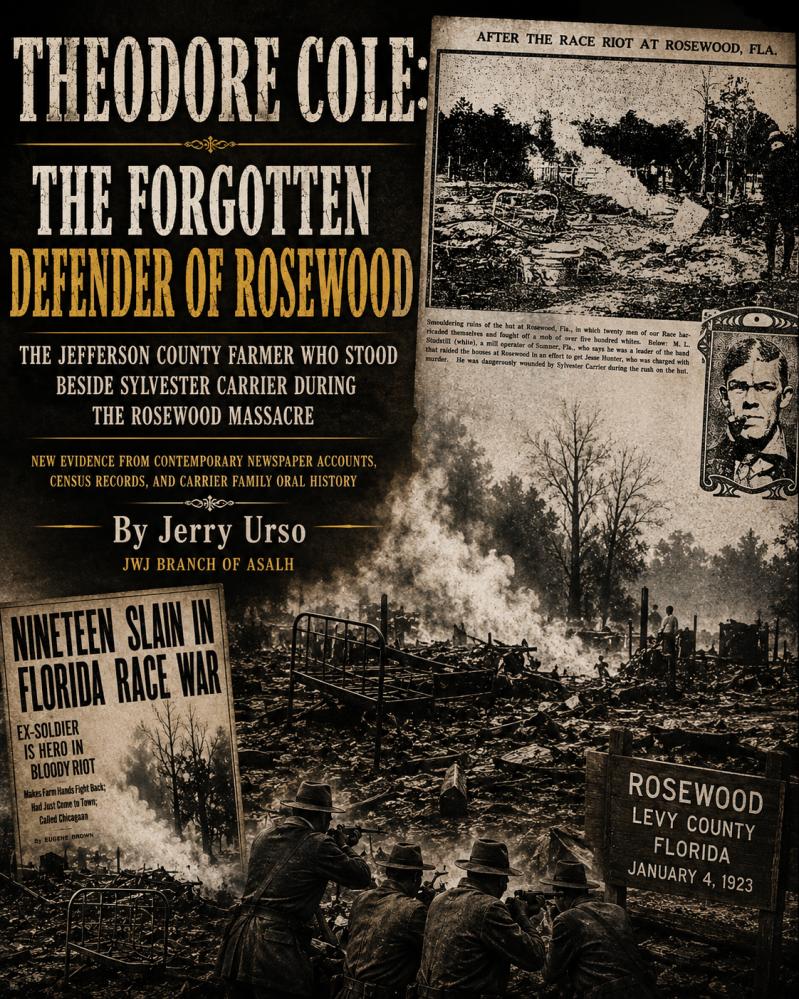
Theodore Cole
The Forgotten Defender of Rosewood
The Jefferson County Farmer Who Stood Beside Sylvester Carrier
New Evidence from Contemporary Newspaper Accounts, Genealogical Research, and Family Oral History
By Jerry Urso
JWJ Branch of ASALH
A Forgotten Name Returns to History
For more than one hundred years, the story of the Rosewood Massacre has centered upon one extraordinary man. His name was Sylvester Carrier, and his determined resistance against an armed white mob has become one of the defining stories of courage in Florida history. Books, documentaries, museum exhibits, historical markers, and websites have all recounted the desperate defense of the Carrier home during the first week of January 1923. Yet buried within one of the earliest newspaper accounts of that terrible night is another name, one that history almost completely forgot.
That man was Theodore Cole.
Unlike Sylvester Carrier, Theodore Cole gradually disappeared from the historical record. Although journalist Eugene Brown mentioned him repeatedly in one of the earliest and most detailed contemporary accounts of the Rosewood Massacre, later historians seldom attempted to discover who he was. His name survived, but the man behind it seemed lost forever.
Today, more than one hundred years after Rosewood burned, newly assembled evidence allows Theodore Cole to emerge from history once again. State and federal census records now identify him as a Black farmer who lived in Wacissa, Jefferson County, Florida, from at least 1885 through 1935.[1-7] Those records establish that Brown was not writing about an anonymous figure or a legendary defender whose identity disappeared with time. He was writing about a real man whose life can now be documented through official records.
More importantly, Brown's remarkable article raises significant questions about one of the most debated aspects of the Rosewood Massacre itself.
For decades, the accepted historical narrative has maintained that Sylvester Carrier was killed during the defense of the Carrier home, a conclusion repeated in numerous books, documentaries, historical websites, and public exhibits. Yet Brown's account, written from Tallahassee only days after the massacre, presents a chronology that differs from the narrative that later became widely accepted. Brown attributes statements directly to Carrier while recounting the battle, presenting him as a living participant in the events rather than simply reporting him as dead.[8]
That contemporary account is especially noteworthy because it closely parallels the longstanding oral history preserved by members of the Carrier family. During a recent interview with the author, Lizzie Jenkins, Sylvester Carrier's niece, reaffirmed her family's belief that her uncle survived the attack. For generations, members of the Carrier family have rejected the later narrative that Sylvester died during the siege of the Carrier home. Brown's article does not, by itself, resolve the question of Carrier's ultimate fate, but it does provide strong contemporary evidence that the earliest published reporting differed significantly from later historical interpretations.[8][9]
The rediscovery of Theodore Cole therefore represents more than the identification of a forgotten defender. It brings together three independent bodies of evidence that have rarely been examined together: Eugene Brown's contemporary reporting from Tallahassee, official census records identifying Theodore Cole, and the oral history preserved by the Carrier family. Collectively, these sources invite historians to take a fresh look at one of the most important episodes in Florida history.
The timing of Rosewood also helps explain why Theodore Cole's actions carried such significance.
Only weeks before the massacre, North Florida had already experienced another outbreak of racial violence in Perry, Florida, where armed white mobs attacked the Black community in what became known as the Perry Massacre. The killings shocked Black communities throughout the region. Churches spoke of the violence from their pulpits. Railroad workers carried the news from town to town. Farmers discussed the tragedy in country stores and crossroads communities. Families throughout North Florida understood that another Black settlement could become the next target without warning.
Jefferson County lay within that atmosphere of fear.
Living in Wacissa, Theodore Cole could hardly have escaped hearing about Perry. Like thousands of African Americans throughout North Florida, he witnessed a region where racial violence had become an increasingly common reality rather than an isolated tragedy. Long before Rosewood became a national headline, Theodore Cole already understood that Black families often received little protection when mobs gathered.
Yet nothing in the official records describing Theodore Cole suggests that history would one day remember him for anything other than farming.
Born about 1875, only a decade after emancipation, Theodore belonged to the first generation of African Americans to reach adulthood in freedom. His parents were both born in Florida, and the earliest surviving record of his life appears in the 1885 Florida State Census, where he is listed as a young Black resident of Wacissa in Jefferson County.[1]
Fourteen years later he married Nancy Cole, beginning a partnership that would last for decades.[4] Together they raised six children—Rebecca, Tucker, Alberta, Charlotte, Estelle, and George—while Theodore gradually built one of the area's successful Black farming operations.[2][3][5][6]
The census records quietly reveal a remarkable story of perseverance. In 1900, Theodore earned his living as a farm laborer.[2] By 1910, he had established a growing household and was employing additional help on the farm.[3] The 1920 census describes him as an independent farmer working on his own account, while the 1930 census records that he had achieved the dream shared by countless Black farmers throughout the South by becoming the owner of his own farm.[5][6] The 1935 Florida State Census shows Theodore and Nancy still together after more than thirty-five years of marriage, sharing their home with their daughter Estelle and several grandchildren, evidence that Theodore had become the respected patriarch of a multigenerational family.[7]
Nothing in those quiet census entries hints that Theodore Cole would soon find himself standing in one of the most famous battles in Florida history.
That story would be told not by a census taker, but by a newspaper reporter named Eugene Brown, writing from Tallahassee while the smoke of Rosewood still hung over Levy County.
The Defense of the Carrier Home
By the time Eugene Brown reached Tallahassee to investigate the Rosewood Massacre, stories of the battle at the Carrier home had already spread across North Florida. Survivors were emerging from the swamps, families were searching for loved ones, and newspapers throughout the country struggled to separate rumor from fact. Brown's account stands apart because it was written only days after the violence, while witnesses were still recounting what they had seen. Unlike many later histories that relied upon recollections gathered decades afterward, Brown was documenting events while memories remained fresh and before a single narrative had become firmly established.[8]
According to Brown, the confrontation centered upon the home of Sarah Carrier, where women and children sought refuge while a handful of armed Black men prepared to defend them. As white men from surrounding counties poured into Rosewood, convinced that the Black residents would quickly surrender, they instead encountered determined resistance from men who understood that their families faced almost certain death if the mob entered the house.[8]
Among those defenders stood Sylvester Carrier, whose courage has become legendary, and beside him stood Theodore Cole, whom Brown immediately distinguished from the other men by identifying him as a former sergeant. Brown believed that detail mattered because military experience was desperately needed inside the Carrier home. Most of the defenders were farmers and laborers who had never faced organized combat. Theodore Cole, however, had learned discipline under fire, and Brown portrays him as the man who transformed fear into determination.[8]
As the armed mob gathered outside, Brown wrote that anxiety spread through the crowded house. The defenders could hear shouting, see armed men moving into position, and understand that they were hopelessly outnumbered. It was then, according to Brown, that Theodore Cole gathered the men and spoke to them with the authority of someone who understood both battle and human nature. Rather than allowing fear to dictate their actions, he reminded them what surrender would mean. The mob had already demonstrated throughout the South what happened to Black men who trusted mercy from armed vigilantes. Their wives, mothers, sisters, and children were depending upon them. If death was coming, Brown reported that Cole urged them to meet it standing together rather than waiting helplessly for the mob to decide their fate.[8]
Brown's description leaves little doubt that Cole's words changed the spirit inside the Carrier home. The frightened men who only moments earlier questioned whether resistance was possible became defenders prepared to fight for every room of the house. Brown does not portray Theodore Cole as a reckless man eager for violence. Instead, he presents him as someone who believed resistance had become the only remaining choice after law and order had collapsed around them.[8]
As darkness settled over Rosewood, the shooting began.
Brown describes the attack as fierce and relentless. Rifle fire ripped through the wooden walls while bullets shattered windows and splintered doors. Women and children huddled together as gunfire echoed through the small house. Outside, the attackers believed that overwhelming numbers alone would quickly crush the defenders. Inside, Theodore Cole understood that victory depended not upon numbers but upon discipline.[8]
Drawing upon his military experience, Brown wrote that Cole instructed the defenders not to waste ammunition. Every cartridge had become precious. Instead of firing wildly into the darkness, he ordered the men to wait until attackers exposed themselves through openings already created in the walls. Each defender was to aim carefully and conserve ammunition for the moments when it could do the greatest damage. Brown credits this disciplined approach with frustrating repeated attempts to rush the house. The attackers expected frightened farmers. Instead, they encountered organized resistance directed by a man who understood battlefield tactics.[8]
Again and again, according to Brown, the mob attempted to overrun the Carrier home. Again and again, accurate rifle fire forced them back. Brown reported that members of the attacking force fell during these assaults, while others retreated in confusion after discovering that the defenders inside were fighting with remarkable discipline. Theodore Cole's leadership had transformed a desperate defense into an organized stand that lasted far longer than anyone outside the house expected.[8]
Unable to break through by direct assault, the mob eventually abandoned hopes of capturing the house intact. Brown wrote that they turned instead to fire, believing flames would accomplish what bullets had failed to achieve. As smoke filled the rooms and fire began consuming the structure, the defenders faced an impossible choice. Remaining inside meant certain death. Surrender meant trusting a mob whose actions had already shown little regard for Black lives.[8]
According to Brown, Theodore Cole refused to allow panic to replace discipline even in those final moments. As flames spread through the Carrier home, he organized the remaining defenders for a fighting withdrawal. Timing their escape carefully, they broke through the attackers' lines while continuing to return fire, disappearing into the darkness and surrounding woods as the house burned behind them. Brown presents their escape not as a chaotic flight but as an organized military withdrawal that denied the mob the complete victory it had expected.[8]
Throughout Brown's account, Theodore Cole appears not merely as another defender but as one of the principal leaders of Rosewood's resistance. While Sylvester Carrier became the symbol of courage, Brown portrays Theodore Cole as the man whose military experience, discipline, and leadership enabled that courage to become an effective defense against overwhelming odds. More than a century later, his account restores Theodore Cole to the place Brown believed he deserved among the defenders of Rosewood.[8]
A Contemporary Account Challenges the Accepted Narrative
One of the most remarkable aspects of Eugene Brown's reporting is not simply that he preserved the name of Theodore Cole. His article also preserves one of the earliest surviving narratives concerning the fate of Sylvester Carrier, and that narrative differs significantly from the version that later became accepted by many historians.
For decades, books, documentaries, museum exhibits, historical websites, and public commemorations have generally stated that Sylvester Carrier died during the siege of the Carrier home on the night of January 4, 1923. That conclusion eventually became accepted as the standard account of Rosewood and has been repeated so frequently that few readers have questioned its origin. Yet Brown's article, written only days after the massacre while witnesses were still available for interview, presents a much more complicated picture.[8][10][11]
Rather than simply reporting that Carrier had been killed, Brown attributes direct statements to Sylvester Carrier while describing the events surrounding the battle. Throughout the article, Carrier is presented not merely as a fallen defender but as a participant whose own words became part of Brown's narrative. As a journalist, Brown clearly believed he was reporting information gathered immediately after the massacre from people who had firsthand knowledge of the events. Whether Brown spoke directly with Carrier or recorded statements supplied by those who had spoken with him cannot now be determined with certainty, but the article itself demonstrates that Brown did not understand Carrier's fate in the same manner that later historians would describe it.[8]
That distinction is historically significant.
Brown's report appeared in the Chicago Defender only days after the massacre and carried a Tallahassee dateline. Unlike later accounts written decades afterward, Brown was documenting events before memories had faded and before a single historical interpretation had emerged. His article therefore represents one of the earliest surviving African American newspaper accounts of Rosewood and deserves careful consideration whenever historians examine the events surrounding the Carrier home.[8]
Equally important is the remarkable similarity between Brown's reporting and the oral history preserved within the Carrier family itself.
For generations, members of the Carrier family maintained that Sylvester Carrier survived the attack. During a recent interview with the author, Lizzie Jenkins, Sylvester Carrier's niece, reaffirmed that her family has never accepted the later narrative that her uncle died during the siege of the Carrier home. According to Jenkins, the family's history has consistently maintained that Sylvester survived and lived beyond the events at Rosewood.[9]
The convergence between Brown's contemporaneous reporting and the Carrier family's oral history deserves serious scholarly attention. Brown's article does not stand alone. Neither does the family's tradition. Together they represent two independent bodies of evidence that differ from the interpretation later adopted by many secondary historical works. While later authors concluded that Carrier died during the battle, Brown's article demonstrates that the earliest published reporting presented a different chronology, while the Carrier family continued preserving that alternative account for more than one hundred years.[8][9]
The purpose of historical research is not to dismiss one source in favor of another but to examine all available evidence honestly. Brown's article should therefore not be ignored simply because it differs from later interpretations. It is a contemporary source created within days of the massacre. Likewise, family oral history should not be dismissed merely because it survived through generations rather than official documents. Oral traditions have often preserved details later confirmed through documentary research, particularly within African American communities where official records were frequently incomplete or entirely absent.
The rediscovery of Theodore Cole illustrates precisely why primary sources deserve renewed examination. For decades, historians knew only that Brown mentioned a man named Theodore Cole. They could not identify him. Today, census records establish that Theodore Cole was a Black farmer living in neighboring Jefferson County before, during, and after the Rosewood Massacre.[1-7] Brown's account, once viewed as containing an unidentified participant, can now be connected to a documented individual whose life is preserved through official records.
That discovery naturally encourages historians to reconsider other portions of Brown's reporting as well.
If Brown accurately preserved the identity of Theodore Cole—a man later generations failed to identify—what other details contained in his account deserve renewed examination?
That question does not diminish the work of earlier historians. Instead, it demonstrates how historical understanding continues to evolve as new evidence is assembled and previously overlooked records are connected. The identification of Theodore Cole represents more than the recovery of one forgotten defender. It reminds us that history is rarely complete and that contemporary sources often contain important details overlooked by later generations.
More than one hundred years after Rosewood, Theodore Cole has finally emerged from obscurity. He is no longer merely a name appearing briefly in an old newspaper. He was a husband, a father, a successful Black farmer, and, according to Eugene Brown's remarkable contemporary account, one of the principal leaders who stood beside Sylvester Carrier during the desperate defense of the Carrier home. His rediscovered life restores another courageous man to the story of Rosewood while inviting historians to continue examining one of the most important and enduring chapters in Florida's history.
References
[1] Florida, U.S., State Census, 1885, Wacissa, Jefferson County, Florida.
[2] 1900 United States Federal Census, Wacissa, Jefferson County, Florida.
[3] 1910 United States Federal Census, Wacissa, Jefferson County, Florida.
[4] Marriage Record of Theodore Cole and Nancy Cole, 1899.
[5] 1920 United States Federal Census, Wacissa, Jefferson County, Florida.
[6] 1930 United States Federal Census, Wacissa, Jefferson County, Florida.
[7] Florida, U.S., State Census, 1935, Precinct 11, Jefferson County, Florida.
[8] Eugene Brown, "Nineteen Slain in Florida Race War: Ex-Soldier Is Hero in Bloody Riot," The Chicago Defender (National Edition), January 13, 1923, pp. 1, 8.
[9] Interview with Lizzie Jenkins, niece of Sylvester Carrier, conducted by Jerry Urso, July 2026.
[10] Equal Justice Initiative. "Rosewood Massacre." Historical Calendar.
[11] Remembering Rosewood Foundation. "History of Rosewood." Historical overview.
This article represents the first known synthesis of Theodore Cole's documented genealogy, Eugene Brown's contemporary reporting, and the Carrier family's oral history into a single historical narrative.
