
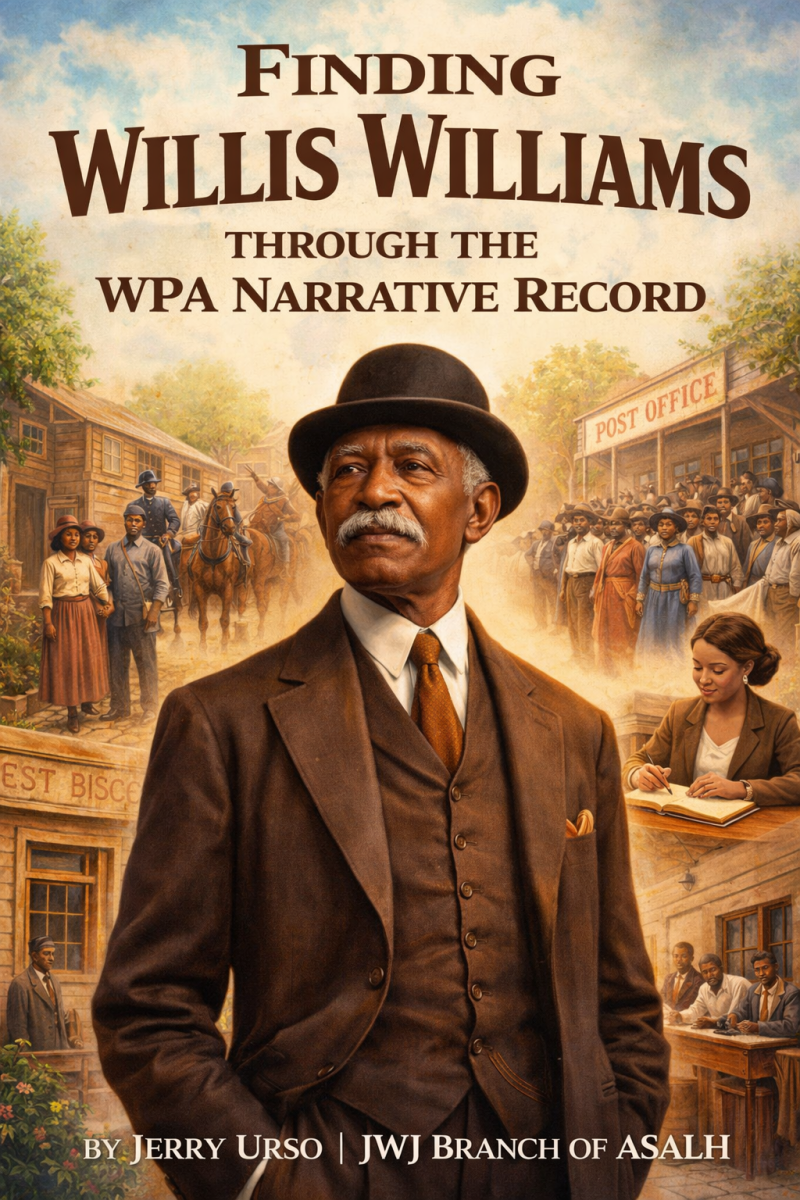
Finding Willis Williams
Recovering the Story of a Reconstruction-Era Postal Pioneer Through the WPA Slave Narrative Collection
When Viola Muse, a field worker with the Federal Writers’ Project, sat down with Willis Williams at 410 Broad Street in Jacksonville, she was speaking with a man whose memory stretched back to slavery in territorial Florida and forward into the modern urban world of the twentieth century. By the time of her interview, Williams was already recognized locally as one of the surviving witnesses of an earlier generation whose experiences connected Reconstruction-era Florida to the institutional life of Black Jacksonville. Muse’s visit preserved more than recollection; it preserved a bridge between eras that might otherwise have disappeared with him. [1]
Williams explained that he had been born in Tallahassee in September 1857, in the household of Dr. W. H. Heyward, where his earliest memories were formed not simply by labor expectations but by the rhythms of a structured domestic plantation environment. His mother’s role in the household left a particularly vivid impression on him. He remembered her making clothing for the family—cutting, stitching, and repairing garments that sustained both the plantation household and its enslaved workers. In later life, this memory remained one of the clearest symbols of how enslaved families preserved dignity and stability within constrained circumstances. [2]
Childhood also meant learning how survival extended beyond the plantation yard itself. Williams recalled being sent into nearby wooded areas to gather small food items—berries, nuts, and other provisions—which supplemented the plantation diet and formed part of the informal subsistence practices common among enslaved children across North Florida. These memories reveal a landscape in which children moved between supervision and responsibility early, learning how to navigate both cultivated fields and surrounding forests long before emancipation transformed their legal status. [3]
His recollections of emancipation were equally concrete and deeply local. Williams remembered that freedom came not as an abstract proclamation but as an event announced on the plantation itself, followed by a celebration arranged by the former owner. The gathering, remembered decades later, reflected a transitional moment shared across many Leon County plantations where emancipation arrived through a combination of Union presence, local negotiation, and public acknowledgment rather than a single dramatic confrontation. For Williams, the celebration marked the first moment he understood that the world he had been born into was ending. [4]
He also remembered the arrival of United States Colored Troops, including soldiers he later identified with the 99th U.S. Colored Infantry, whose presence made the meaning of emancipation unmistakable to the enslaved population of the region. Their appearance confirmed what rumor alone could not: that freedom was backed by federal authority and defended by Black soldiers themselves. For a child who would later enter federal service as an adult, this early encounter with uniformed Black troops represented one of his earliest memories of African American participation in national power. [5]
Williams’s father soon secured employment connected with railroad labor after emancipation, part of the expanding transportation networks that reshaped Florida during Reconstruction. This transition from plantation labor to wage-based work introduced the Williams family to a new world defined by movement, schedules, and opportunity. In later years, when Willis Williams himself entered the federal postal service and began traveling the rail corridors of the state, those childhood memories of his father’s railroad employment formed part of the continuity he recognized between emancipation and advancement. [6]
By the time Viola Muse recorded his testimony in Jacksonville decades later, Williams understood that his life had carried him from slavery in Tallahassee to participation in one of the most respected federal professions open to Black men of his generation. Yet in recounting his earliest years, he did not begin with institutions or titles. He began with his mother’s sewing, the woods near the plantation, the celebration of emancipation, and the sight of Black Union soldiers. Those memories anchored everything that followed. [7]
Life on the Tallahassee Plantation
When Willis Williams described his earliest years to Federal Writers’ Project interviewer Viola Muse at 410 Broad Street in Jacksonville, he began not with institutions or public achievements but with the structure of family life on the Tallahassee plantation where he had been born in September 1857. His memories preserved a picture of childhood shaped by household labor responsibilities and by the skilled work performed within his own family during the final years of slavery in Middle Florida. [8]
At the center of those memories stood his mother, who served as the plantation cook and also made clothing for members of the household. Cooking on a plantation required organization and endurance and placed enslaved women at the center of daily operations within both the quarters and the owner’s domestic space. In addition to preparing meals, she cut and repaired garments that sustained plantation life through continual use and reuse. Her responsibilities reflected the skilled domestic labor that supported the functioning of plantation households from within. [9]
Williams also recalled that his father worked as a carpenter, a position requiring technical skill and responsibility within the plantation labor system. Enslaved carpenters constructed and repaired buildings, maintained structures, and contributed directly to the physical operation of plantation property. His father’s work formed part of the skilled labor environment in which Williams spent his early childhood and helped shape the household setting in which he was raised. [10]
As a boy, Williams assisted directly in his mother’s clothing work. He remembered being sent into nearby wooded areas to gather indigo plants used for dyeing cloth, one of the earliest responsibilities he carried as a child. This recollection reveals that garment production on the plantation depended not only on sewing but also on knowledge of natural materials found in the surrounding landscape. Through these errands he participated in the household economy that sustained enslaved families during his earliest years. [11]
These trips into the woods also formed part of the broader pattern of childhood responsibility common among enslaved children in Leon County. Moving between the quarters, household work spaces, and nearby wooded areas, he learned early how labor structured daily life long before emancipation altered his legal condition. His recollections show that even small tasks connected children directly to the functioning of plantation society. [12]
Williams later remembered that emancipation itself was marked by a gathering held on the plantation by the former owner, an event that remained vivid in his memory decades later. Rather than arriving as a distant proclamation, freedom appeared to him as a local moment publicly recognized within the plantation community. The celebration marked the end of one order and the beginning of another, helping translate national change into lived experience for those who had been born into slavery. [13]
Taken together, these recollections show that Williams’s childhood unfolded within a household shaped by skilled domestic and craft labor, including his mother’s responsibilities as cook and clothing maker and his father’s work as a carpenter, as well as his own participation gathering indigo used in dyeing cloth. These early experiences formed the foundation of the transition he would soon make into the educational and occupational opportunities that emerged during Reconstruction. [14]
Union Troops, the Closing Months of Slavery, and the Approach of Freedom in Leon County
By the final months of the Civil War, the Tallahassee region where Willis Williams spent his childhood stood at the edge of transformation. Although Leon County remained one of the last Confederate-controlled areas in Florida, news of Union movements and the presence of federal forces circulated steadily through plantation districts. Even as a child, Williams later remembered the growing awareness among enslaved families that the system into which they had been born was weakening. These changes formed the immediate background to his earliest understanding of freedom as something approaching, not distant. [15]
One of the defining military events shaping conditions around Tallahassee during this period was the Battle of Natural Bridge in March 1865, when Confederate forces attempted to prevent Union troops advancing from the Gulf Coast from reaching the capital. Although the Confederate defense temporarily delayed the capture of Tallahassee itself, the broader military situation across Florida made clear that the Confederacy could no longer maintain control of the region. For enslaved families in Leon County, the battle represented not a preservation of the old order but one of its final defensive efforts. Williams’s childhood unfolded in precisely this atmosphere of uncertainty and expectation. [16]
In the weeks that followed, the expanding presence of United States Colored Troops operating across North Florida made the meaning of emancipation increasingly visible to enslaved communities. Williams later recalled the arrival of Black Union soldiers—men he identified with the 99th United States Colored Infantry—whose appearance confirmed that freedom rested on federal authority and would be enforced by armed representatives of the United States government. For a child who had grown up within the structure of plantation labor, the sight of African American soldiers in uniform represented one of his earliest encounters with Black participation in national power. [17]
The presence of these troops carried importance beyond their immediate military role. Across Florida, units of the United States Colored Troops helped secure transportation corridors, protect newly freed communities, and stabilize regions transitioning from slavery to freedom. Their movement through plantation districts signaled that emancipation was no longer uncertain or conditional. Instead, it had become part of a new political reality backed by federal force. Williams’s memory of their arrival reflects how deeply their presence shaped the experience of freedom for those who witnessed the transition firsthand. [18]
Seen from the perspective of his later life in Jacksonville, Williams understood that these events marked the turning point separating his childhood in slavery from the opportunities that followed during Reconstruction. The approach of Union troops and the appearance of Black soldiers in the Tallahassee region formed the bridge between plantation life and the new world of schooling, skilled employment networks, and federal service that would soon become possible to him and to others of his generation. [19]
Emancipation, Celebration, and the First Experiences of Freedom in Leon County
For Willis Williams, emancipation did not arrive as a distant announcement carried only through rumor or official proclamation. He remembered that freedom was marked on the plantation itself by a gathering arranged by the former owner, an event that translated national change into something immediate and visible within the community where he had been born. Like many formerly enslaved children in Leon County, Williams experienced emancipation first as a shared local moment before he understood its legal meaning. The celebration marked a transition not simply in status but in expectation. [20]
Across the Tallahassee plantation belt, similar scenes unfolded during the spring and summer of 1865 as enslaved families moved cautiously from dependence toward autonomy. Plantation owners sometimes attempted to manage the transition through announcements, meetings, or negotiated arrangements intended to stabilize labor conditions after emancipation. For formerly enslaved families, however, these gatherings often became the first public acknowledgment that the authority governing their lives had permanently changed. Williams’s memory preserves one of these transitional moments from the perspective of a child who witnessed the end of slavery within the place where he had lived it. [21]
In later years, such memories helped shape his understanding of Emancipation Day celebrations, which became an important tradition among African American communities throughout Florida. Annual observances marked not only the legal end of slavery but also the survival and advancement of those who had lived through its final years. As a member of the generation that had personally witnessed emancipation, Williams belonged to a small and increasingly respected group whose presence at these commemorations gave the celebrations historical meaning as well as ceremonial importance. [22]
These early experiences of freedom also coincided with the first signs of expanding opportunity for formerly enslaved families in Leon County. As Reconstruction began, access to schooling, wage labor, transportation work, and emerging Black institutional life began to reshape the possibilities available to children like Williams. His memories of emancipation therefore stood not as isolated recollections but as the beginning of a transition that would soon carry him beyond plantation life and into the developing educational and occupational networks of postwar Florida. [23]
Reconstruction Childhood, Schooling, and the Transition from Plantation Labor to Skilled Opportunity
The years immediately following emancipation marked the first true turning point in the life of Willis Williams. Like many children born into slavery in Leon County, he moved from a world defined by plantation labor expectations into one shaped by the expanding opportunities of Reconstruction. Freedom did not transform conditions overnight, but it opened pathways that had been legally impossible only a few years earlier. For Williams, the most important of these early changes was access to education. [24]
Williams later recalled that he attended school during the Reconstruction period, part of the first generation of African American children in Florida able to pursue literacy in an organized classroom setting after emancipation. Across Leon County and the Tallahassee region, freedmen’s schools supported by federal agencies, missionary societies, and Black community leadership formed the foundation of this transformation. These schools represented more than instruction; they marked the beginning of participation in civic life and economic mobility for a generation that had been born without legal access to education. His attendance placed him within this historic first wave of post-emancipation students. [25]
At the same time, changes within his own household reinforced this movement toward independence and skilled employment. Williams remembered that his father, who had worked as a carpenter during slavery, continued to pursue skilled labor after emancipation and became connected with railroad-related work, part of the expanding transportation infrastructure reshaping Florida during Reconstruction. Railroads created new employment networks for formerly enslaved men across North Florida, linking interior communities such as Tallahassee with coastal and commercial centers. Exposure to this environment helped introduce Williams to a world structured not by plantation routine but by schedules, routes, and mobility. [26]
The railroad corridors that developed across Florida during these years played an especially important role in shaping opportunities for young African American men seeking stable employment after emancipation. They connected communities, carried mail, transported labor, and supported the growth of new towns across the state. For Williams, whose father’s work placed him in proximity to this expanding transportation system, the railroad represented one of the earliest examples of the changing economic landscape that Reconstruction made possible. [27]
These developments formed the bridge between his childhood in Leon County and the occupational path he would later follow. Education introduced literacy. Skilled labor within his family demonstrated the value of technical ability. Railroad expansion revealed the structure of a wider economic world beyond plantation boundaries. Together, these influences prepared Williams for the transition he would soon make into one of the most respected federal occupations available to African American men of his generation: service in the Railway Mail Service, where transportation networks and literacy combined to create new opportunities in the decades after Reconstruction. [28]
Entry into the Railway Mail Service and the Opening of a Federal Career
By the late nineteenth century, the educational opportunities that followed emancipation and the example of skilled labor within his own household helped prepare Willis Williams for entry into one of the most respected federal occupations available to African American men of his generation: service in the Railway Mail Service. At a time when stable federal employment represented both economic security and public recognition, positions connected to the postal system carried particular importance within Black communities across Florida. Williams’s appointment marked his transition from Reconstruction-era student to participant in the expanding national infrastructure that connected Southern cities through rail and communication networks. [29]
The Railway Mail Service required discipline, literacy, and reliability. Clerks sorted mail in moving railcars along established routes linking interior communities with commercial centers across the state and beyond. Williams later remembered working alongside other African American postal clerks traveling the Florida rail corridors, including men he identified as Cox, Hughes, and Myers, colleagues whose presence reflected the small but growing network of Black federal employees operating within the transportation system of the post-Reconstruction South. Their work placed them in constant motion between towns and cities, carrying correspondence that linked families, businesses, churches, and political organizations across the region. [30]
Service in the Railway Mail Service also represented an important step forward from the forms of labor available to most formerly enslaved men only a generation earlier. Postal employment required both literacy and trust, and those who secured such positions occupied a respected place within their communities. Williams’s participation in this work demonstrated not only personal advancement but also the broader transformation taking place among African Americans in Florida during the decades following emancipation. His career reflected the emergence of a professional class whose employment connected local communities directly to federal institutions. [31]
Census records later confirmed his connection to postal service employment. By 1920, Williams was recorded in Jacksonville as a postal clerk in the Post Office, evidence that his association with federal mail work extended across decades and remained central to his occupational identity well into the twentieth century. The listing preserved in the federal census provides documentary confirmation of the career he described in his own recollections and illustrates the long-term stability that postal employment offered him after the uncertainties of his childhood under slavery. [32]
Work along Florida’s rail corridors also introduced Williams to the expanding urban networks that would eventually shape the next phase of his life. Railway mail routes connected Tallahassee with Jacksonville and other growing commercial centers, exposing postal clerks to the institutional life developing within Black communities across the state. Through this experience, Williams became part of the transportation system that supported communication, migration, business development, and organizational growth among African Americans in Florida during the late nineteenth century. These connections would soon influence his relocation to Jacksonville, where his federal career, fraternal leadership, church involvement, and public presence became firmly established. [33]
Arrival in Jacksonville and Entry into LaVilla’s Expanding Black Institutional World
At some point during the later years of his Railway Mail Service career, Willis Williams relocated to Jacksonville, the city that would become the center of his adult life and public identity. By the closing decades of the nineteenth century, Jacksonville—particularly the neighborhood of LaVilla—had emerged as one of the most important centers of African American institutional growth in Florida. For formerly enslaved men who had secured literacy and federal employment during Reconstruction, the city offered opportunities for civic participation, fraternal leadership, church involvement, and economic stability that were not available in smaller interior communities. Williams’s move placed him directly within this expanding urban environment. [34]
LaVilla functioned as the heart of Black Jacksonville during the late nineteenth and early twentieth centuries. Churches, fraternal lodges, schools, businesses, and mutual aid organizations created a dense institutional network that supported African American advancement in the decades following emancipation. Residents who held stable occupations—especially federal employees such as postal clerks—often became central figures within these organizations. Williams’s federal service positioned him among the respected working professionals who helped sustain this civic structure. [35]
Census evidence confirms that by 1900 Williams was living in Jacksonville with his wife Mary C. Williams and their children on Ashley Street, within the LaVilla district. His occupation at that time was recorded as liquor dealer, illustrating that his economic activity extended beyond federal employment and into the commercial life of the neighborhood. Such dual participation in both government service and local business activity was common among African American professionals seeking stability in rapidly growing Southern cities at the turn of the century. The household listing also confirms that the Williams family had established a permanent presence in Jacksonville by this period. [36]
Later census records continued to document his residence within Jacksonville’s Black community. By 1920, he appeared as a postal clerk living as a roomer on Duval Street, and subsequent listings in 1930, 1935, and 1940 placed him on Everson Street, where he remained part of the neighborhood’s residential network into advanced age. These records demonstrate the remarkable continuity of his life within Jacksonville across multiple decades, confirming that the city served as the principal setting of his civic and institutional activity after his years in Tallahassee. [37]
Jacksonville also provided the environment in which Williams’s presence began to intersect with the organized fraternal life of African American Florida. During the late nineteenth century, Prince Hall Freemasonry played a central role in shaping Black leadership networks across the state, and LaVilla served as one of its most active centers. Williams’s later appearance in Masonic contexts—including his role as a pallbearer at the funeral of Grand Master William M. Mays—demonstrates that his standing within these circles had become widely recognized. His residence in Jacksonville placed him within the institutional setting where that recognition could develop. [38]
Seen in the broader context of his life, Williams’s arrival in Jacksonville represented more than a change of residence. It marked his transition from the Reconstruction landscape of Leon County into one of the most important urban centers of African American civic life in Florida. Within LaVilla’s churches, fraternal organizations, transportation networks, and neighborhoods, he became part of a generation whose lives connected emancipation-era memory with the institutional strength of twentieth-century Black Jacksonville. [39]
Prince Hall Freemasonry, Public Standing, and Recognition within Florida’s Black Leadership Community
By the early twentieth century, Willis Williams had become part of the fraternal networks that helped structure African American civic leadership in Jacksonville through his association with Prince Hall Freemasonry, one of the most important institutional foundations of Black community organization in Florida after Reconstruction. Membership in Prince Hall lodges linked education, mutual aid, ceremony, and public respectability, and it was especially characteristic of men whose lives bridged slavery and citizenship. Williams belonged to that generation whose authority rested as much on lived memory as on office. [40]
Williams was a member of Silver Star Lodge No. 5 in Jacksonville, a lodge that operated during the period when John G. Riley served as Worshipful Master prior to the jurisdictional division within Florida Prince Hall Masonry. His connection with this lodge places him within the Jacksonville fraternal environment shaped by Riley’s leadership during the years immediately preceding the separation that produced competing Prince Hall jurisdictions in the state. [41]
His later appearance as a pallbearer at the funeral of Grand Master William M. Mays indicates that his affiliation followed the leadership associated with Mays after the division rather than remaining with the Riley jurisdiction. Service in that role reflected recognition within the circle surrounding Mays and confirms his standing within Jacksonville’s Prince Hall Masonic community during a period when jurisdictional alignment carried institutional significance across Florida’s Black fraternal landscape. [42]
Within Jacksonville—particularly in LaVilla, where fraternal halls stood alongside churches, schools, and mutual aid societies—Prince Hall Masonry functioned as both a ceremonial order and a civic framework supporting Black advancement. Williams’s participation in this environment reflected the broader pattern through which formerly enslaved men who secured literacy and stable employment later assumed visible roles within institutional leadership circles. His Masonic affiliation therefore formed part of the larger public identity he carried as one of the surviving witnesses of emancipation whose life connected the plantation generation to the organized civic world of twentieth-century Black Jacksonville. [43]
Skilled Work, Teaching Activity, and Community Participation in Jacksonville
After relocating to Jacksonville, Willis Williams’s life reflected the pattern common among members of the first generation born into slavery but reaching adulthood during Reconstruction: he combined federal employment with skilled labor experience and community-based activity that extended beyond a single occupation. In addition to his work connected with the postal service and railroad mail routes, he recalled participation in carpentry work, continuing the skilled trade tradition that had already shaped his household during childhood through his father’s occupation. Such work remained an important source of stability for African American craftsmen in Jacksonville’s developing neighborhoods during the late nineteenth century. [46]
Williams also described involvement with teaching activity during the Reconstruction period, reflecting the broader movement among newly freed communities to establish schools wherever instruction became possible. In many early freedmen’s schools across North Florida, individuals with basic literacy often assisted in instruction even when they were not formally appointed teachers. His recollection places him within that generation of young men who helped sustain early educational efforts while African American schooling systems were still being organized. [47]
These experiences formed part of a larger pattern of participation in Jacksonville’s institutional environment, especially within the LaVilla district, where churches, fraternal organizations, transportation employment networks, and emerging educational opportunities shaped the structure of Black civic life after emancipation. Men like Williams—who combined literacy, skilled labor ability, and federal employment—frequently moved between occupational roles while contributing to the stability of their communities. His activities therefore reflected not a single profession but a broader pattern of service characteristic of Reconstruction-generation community builders in North Florida. [48]
Ebenezer Methodist Episcopal Church and the Role of an Emancipation Witness in Jacksonville’s Public Memory
As Willis Williams advanced in age, his place within Jacksonville’s African American community increasingly reflected not only his work and fraternal connections but also his status as a living witness to emancipation. Among the institutional settings in which this role carried meaning was Ebenezer Methodist Episcopal Church, one of the central religious bodies serving Black Jacksonville during the late nineteenth and early twentieth centuries. Churches such as Ebenezer functioned not only as places of worship but as centers of education, mutual aid, commemorative activity, and community leadership within the LaVilla district. Williams’s presence within this environment connected his personal memory of slavery directly to the institutional life of the post-Reconstruction generation. [49]
Men of Williams’s generation occupied a respected place within Emancipation observances across Florida because they represented the last living link to the moment of transition from slavery to freedom. Having remembered the plantation gathering that marked emancipation in Leon County during his childhood, he belonged to a shrinking group whose testimony gave authenticity to annual commemorations held in Jacksonville’s churches and civic spaces. Participation by witnesses like Williams transformed Emancipation Day from a ceremonial anniversary into a living historical tradition preserved through personal experience as well as public celebration. [50]
Within Jacksonville’s religious and civic culture, such witnesses were often recognized not simply as elderly residents but as members of the generation that had crossed the boundary between slavery and citizenship. Their presence helped anchor community memory during a period when younger generations were building schools, fraternal organizations, and business institutions across LaVilla. Williams’s role in this setting reflected the broader pattern through which survivors of slavery became respected figures within church-centered commemorative life in early twentieth-century Black Jacksonville. [51]
Through his association with Ebenezer Methodist Episcopal Church and his remembered experience of emancipation itself, Williams’s life continued to connect the plantation world of his childhood with the institutional strength of the community he helped sustain in Jacksonville. His presence in these settings demonstrated how memory, faith, and civic identity combined to preserve the meaning of freedom within the generation that had first lived it. [52]
