
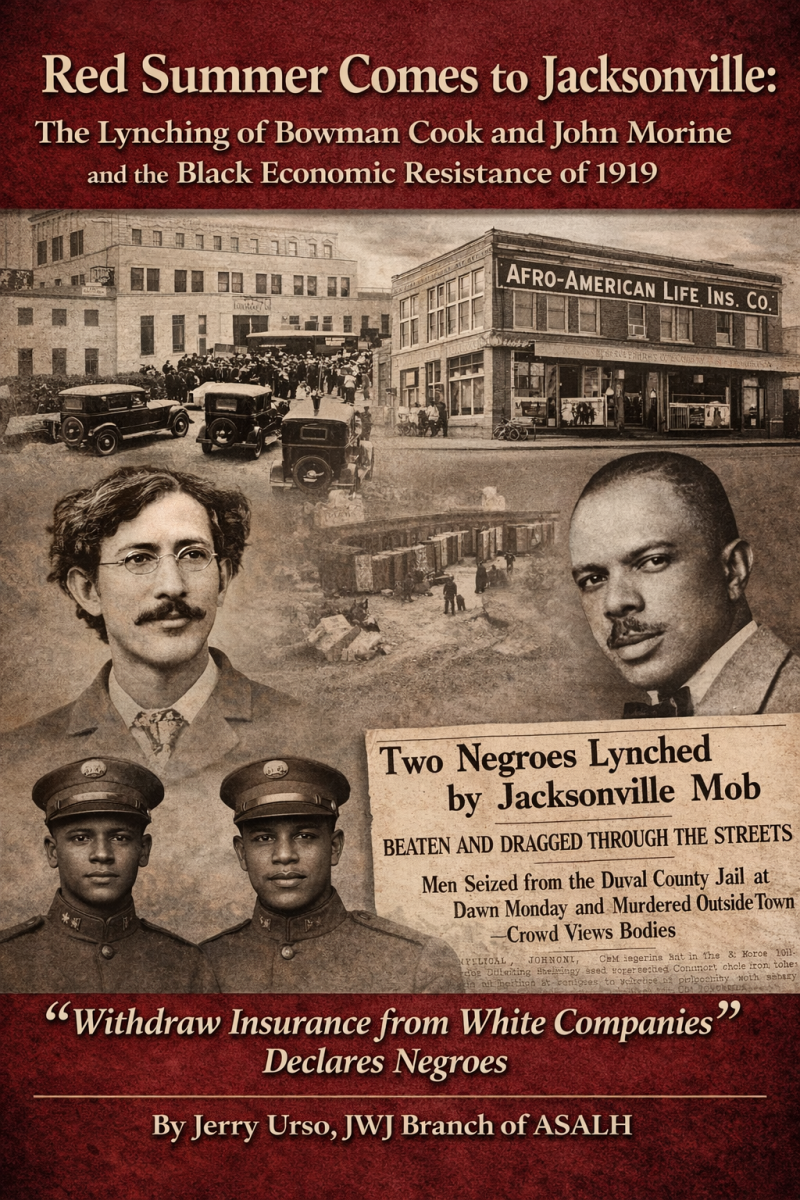
Red Summer Comes to Jacksonville: The Lynching of Bowman Cook and John Morine and the Black Economic Resistance of 1919
By Jerry Urso JWJ Branch of ASALH
Red Summer Comes to Jacksonville
In 1919 the United States entered one of the most violent racial periods in its modern history. Across more than two dozen cities, white mobs attacked Black neighborhoods, seized prisoners from jails, burned homes, and killed civilians in what would later be remembered as the Red Summer. The violence followed immediately after World War I and reflected deep anxieties about labor competition, returning soldiers, and the expanding expectations of Black citizenship. [1]
Jacksonville was one of the southern cities where this national crisis took a particularly dangerous form. Unlike Chicago or Washington, where racial violence emerged from dense industrial competition, Jacksonville’s tensions centered on economic independence inside the Black community and white fears of losing social control over labor, transportation, and finance. In the LaVilla district especially, Black residents had built banks, insurance companies, professional offices, churches, and transportation networks that allowed a level of autonomy rare in the Deep South. [2]
This independence did not go unnoticed.
During the summer of 1919, violence against Black workers began increasing across Jacksonville’s transportation corridors. Cab drivers were attacked, confrontations occurred along Ashley Street, and police patrols intensified inside Black neighborhoods. These developments formed the immediate background to the arrest—and eventual lynching—of Bowman Cook and John Morine on September 8, 1919. [3]
News of the lynching quickly spread beyond Florida. National newspapers carried reports within days, and the violence became part of a larger discussion about racial terror unfolding across the country. Writing soon afterward, James Weldon Johnson—a Jacksonville native and national leader in the NAACP—condemned the event as evidence that mob rule remained one of the greatest threats to American democracy. [4]
At the same time, the Black press framed the violence in explicitly political terms. Among the most influential voices was T. Thomas Fortune, whose commentary placed Jacksonville’s events within a national pattern of racial intimidation designed to suppress Black advancement. His analysis reflected a widespread understanding among African American readers that lynching functioned not simply as punishment, but as enforcement of racial hierarchy. [5]
The deaths of Cook and Morine were therefore not isolated acts. They were the product of a city already moving toward confrontation.
Camp Johnston and the Presence of Black Soldiers in Jacksonville
One of the most important but often overlooked influences on Jacksonville’s racial climate during 1919 was the presence of a major military installation on the city’s west side: Camp Johnston.
Established during World War I as a Quartermaster Corps training facility, Camp Johnston brought thousands of soldiers into the Jacksonville area between 1917 and 1919. The camp trained engineering units, labor battalions, transport specialists, and logistical personnel responsible for supporting the American Expeditionary Forces overseas. Among those stationed there were large numbers of African American troops serving in segregated service units that handled supply movement, construction work, and infrastructure support essential to wartime operations. [6]
Although these soldiers were not always deployed in combat formations, their service remained critical to the war effort. They wore the uniform of the United States Army, received federal pay, and participated directly in the logistical machinery that sustained American forces abroad. Military training camps across the South—including Camp Johnston—therefore became places where traditional racial expectations were quietly challenged.
Jacksonville residents saw Black men marching in formation, working under federal authority, and participating in national defense. That visibility mattered.
Military service changed expectations.
Draft registration records confirm that both Bowman Cook and John Morine were part of the wartime generation shaped by this transformation. Like thousands of African American men across the South, they registered under the Selective Service system during World War I, placing themselves within the national military structure that symbolized both duty and citizenship. [7]
Across the country in 1919, returning soldiers became central figures in Red Summer conflicts. Many refused to accept the older assumptions that Black men should remain silent in the face of violence. Their wartime experiences had exposed them to new environments and new possibilities. In some cases they had served overseas in societies where segregation operated differently than it did in the American South. When they returned home, they brought those expectations with them. [8]
National observers recognized the importance of this shift. Commentators such as James Weldon Johnson repeatedly emphasized that the violence of 1919 reflected white resistance to a changing definition of citizenship shaped by wartime service. The presence of trained Black soldiers unsettled communities accustomed to enforcing racial hierarchy through intimidation. [9]
In Jacksonville, the proximity of Camp Johnston ensured that this transformation unfolded not in abstraction, but in daily view.
Cab Drivers Killed Before the Crisis
Long before the shooting of George W. Dubose placed Jacksonville at the center of regional attention, signs of conflict were already visible in the city’s transportation system. Black cab drivers working the streets between LaVilla and the downtown business district began reporting attacks from white passengers during the summer of 1919. Several incidents involved physical assaults, and at least two drivers were killed under circumstances that deeply alarmed Black residents. [10]
Transportation workers occupied a uniquely vulnerable position within Jacksonville’s racial order. They moved constantly between Black neighborhoods and white commercial districts, interacting with customers whose expectations were shaped by rigid assumptions about service and submission. Any resistance to those expectations—even refusal to transport certain passengers—could provoke retaliation.
As violence increased, some Black drivers began declining fares from white riders altogether.
This decision represented one of the earliest organized forms of resistance in Jacksonville during the Red Summer period. It was not a protest march or a political demonstration, but it was unmistakably collective action. Drivers were asserting a boundary designed to protect their safety in an environment where legal protection was uncertain. [11]
White newspapers interpreted the refusals as signs of disorder. Reports suggested that Black drivers were becoming “insolent” and unreliable, language that reflected broader southern anxieties about labor discipline after the war. Yet within the Black community, the refusals were widely understood as necessary self-defense. [12]
Across the United States in 1919, transportation conflicts frequently became flashpoints for racial violence. Streetcars, taxis, railroad platforms, and shipping yards served as spaces where everyday interactions exposed deeper structural tensions. Jacksonville followed the same pattern.
By late summer the city had already entered a dangerous cycle: attacks on workers produced resistance, resistance produced rumors, and rumors produced fear.
When the shooting of George W. Dubose occurred at Broad and Ashley Streets in August 1919, it did not begin the crisis.
It intensified one that had already begun.
Insurance Discrimination and Black Economic Independence
Before the events of August and September 1919 unfolded, Jacksonville’s Black residents had already spent decades building economic institutions designed to protect themselves from exclusion by white-controlled financial systems. Nowhere was this more visible than in the insurance industry, where discriminatory practices shaped nearly every aspect of family security.
At the turn of the twentieth century, most white-owned insurance companies either refused to insure Black clients or issued policies under unequal terms. One of the most common practices was the so-called “two-thirds rule,” under which Black policyholders paid premiums equal to white customers but received reduced benefits at death. In other cases, higher premiums were charged for identical coverage. Because burial insurance represented one of the most important financial protections available to working families, these policies directly affected whether Black families could bury their dead with dignity. [13]
Jacksonville’s Black leadership responded by creating their own institutions.
Among the most important was the Afro-American Life Insurance Company, founded in 1901 under the leadership of Abraham Lincoln Lewis and several associates determined to provide fair coverage where white companies would not. Beginning with limited capital, the company expanded rapidly and became one of the most influential Black-owned insurance firms in the Southeast, offering burial protection, sickness benefits, and eventually mortgage assistance that strengthened Black homeownership across Jacksonville. [14]
Financial independence extended beyond insurance. The Capital Trust & Investment Company, organized by Sylvanus Henry Hart, provided access to credit in a city where white-controlled banks frequently denied loans to Black borrowers. Fraternal systems such as the Knights of Pythias reinforced this structure through lodge-based sickness and burial support that functioned as an informal insurance network. [15]
Together these institutions transformed LaVilla into one of the strongest centers of Black economic independence in the South. When violence erupted in 1919, Jacksonville’s Black residents possessed not only outrage but leverage.
That leverage would soon become visible in their response to lynching.
The Killing of George W. Dubose
The immediate crisis that led to the arrest of Bowman Cook and John Morine began on the evening of August 20, 1919, at the intersection of Broad and Ashley Streets, one of the busiest corridors of Black commercial life in Jacksonville. There, George W. Dubose became involved in a confrontation that escalated rapidly into violence. [16]
According to contemporary newspaper accounts, the disturbance began when a brick was thrown during an altercation between individuals gathered along the street. During the encounter Dubose drew a pistol and fired shots before being stabbed in the struggle that followed. He later died from the wound. [17]
The location of the incident was significant. Broad and Ashley Streets formed the center of Jacksonville’s Black business district, where transportation services, theaters, restaurants, and professional offices attracted heavy evening traffic. Violence at this intersection therefore carried meaning beyond the immediate confrontation itself. It signaled that racial tension had moved directly into the heart of the city’s most important Black commercial corridor.
Within hours police began searching for suspects across LaVilla and surrounding neighborhoods. Multiple individuals were detained for questioning as authorities attempted to demonstrate control over a situation that was already attracting public attention. Among those eventually arrested were Bowman Cook and John Morine. [18]
White newspapers quickly framed the killing as evidence of growing disorder inside Black neighborhoods. Reports emphasized the presence of armed Black residents and suggested that further violence might follow. Such language reflected patterns seen throughout the South during the Red Summer, where isolated confrontations were often interpreted as signs of organized threat rather than local disputes. [19]
Black observers understood the danger differently.
Writing during the same period, T. Thomas Fortune warned readers that arrests following interracial street confrontations frequently preceded mob violence rather than preventing it. His commentary reflected a long historical experience in which jail custody offered little protection once public anger began to gather around a case. [20]
Jacksonville was moving toward precisely that situation.
Mass Arrests and Rising Tension
Following the arrest of Bowman Cook and John Morine, Jacksonville entered a period of heightened tension marked by increased patrols, expanding rumor networks, and visible concern among city officials that mob violence might occur. Police activity intensified across the LaVilla district as officers conducted searches for additional suspects connected to the death of George W. Dubose. [25]
Another man, Ed Jones, was also taken into custody and at one point believed to be the principal suspect. Authorities quietly removed him from the Duval County Jail after receiving reports that a mob intended to seize him. The transfer revealed that officials clearly anticipated the possibility of extralegal violence, even if they did not publicly acknowledge its likelihood. [26]
Newspaper coverage during this period reflected a growing sense of instability. Reports emphasized the presence of armed Black residents and warned readers that unrest might spread if suspects were not quickly punished. Similar language appeared across the country during the Red Summer, where claims of “armed Negroes” frequently preceded organized mob action. [27]
Within Jacksonville’s Black community, however, the arrests were interpreted not as reassurance but as warning. Experience throughout the South had demonstrated that custody often placed prisoners in greater danger once crowds gathered around a case involving interracial violence. The jail itself could become the site of execution when legal protections collapsed under public pressure.
Writing during the same season of violence, T. Thomas Fortune cautioned readers that lynching frequently followed arrest with disturbing predictability. His analysis reflected decades of observation within the Black press, where jail seizures had become one of the most recognizable patterns of racial terror in the United States. [28]
Jacksonville now stood dangerously close to repeating that pattern.
The Night the Mob Entered the Duval County Jail
Before daylight on September 8, 1919, a masked mob entered the Duval County Jail and removed Bowman Cook and John Morine from custody. The operation was swift, organized, and carried out with a level of coordination that strongly suggested preparation rather than spontaneity. [29]
Reports from Jacksonville newspapers described how the mob overpowered or bypassed jail authorities during the early morning hours before the city had fully awakened. The prisoners were taken from their cells and placed into automobiles waiting outside the facility. From there they were transported west of the city toward a secluded execution site along Evergreen Cemetery Road. [30]
The seizure followed a pattern familiar across the South during the lynching era. Rather than attacking openly during daylight hours, mobs frequently operated in the early morning darkness when resistance was least likely and witnesses were few. Such timing allowed participants to maintain anonymity while still ensuring that news of the event would spread rapidly once daylight arrived.
After reaching the execution site, Cook and Morine were shot and killed.
Their bodies were then returned toward the city and transported into downtown Jacksonville, where one of the most disturbing phases of the violence began. Instead of concealing the killings, the mob displayed the bodies publicly in what contemporary observers recognized as an act intended to reinforce racial control through spectacle. [31]
Across the country during 1919, similar jail seizures occurred in communities already destabilized by wartime change and economic competition. National leaders immediately understood that Jacksonville’s violence formed part of that broader pattern. Among them was James Weldon Johnson, who described lynching during the Red Summer as evidence that mob rule continued to operate openly even when courts and police were present. [32]
The events of that morning confirmed his warning.
The Public Display of the Bodies in Downtown Jacksonville
After the execution of Bowman Cook and John Morine outside the city limits, their bodies were brought back into Jacksonville and displayed in the downtown district in a manner intended to send a clear message to the Black community. Contemporary newspaper accounts reported that the bodies were transported through city streets and left in a visible public location where large numbers of residents could witness the aftermath of the killings. [33]
Such displays were not accidental. Public exposure of lynching victims formed part of a long-established pattern across the South in which violence functioned as communication as much as punishment. The spectacle reinforced racial hierarchy by demonstrating that legal protection could be withdrawn at any moment.
Crowds gathered quickly once news spread that the bodies had been returned to the city. Observers described the scene as tense but controlled, suggesting that the display itself—not spontaneous crowd behavior—was the primary objective of those responsible. [34]
Reports from outside Florida soon carried descriptions of the event across the country. Newspapers in North Carolina, Wisconsin, and beyond repeated the story within days, ensuring that Jacksonville’s violence became part of the national record of Red Summer lynchings. International newspapers also carried accounts of the killings, reflecting the growing global attention directed toward racial violence in the United States following the First World War. [35]
Editorial voices in the Black press responded with particular urgency. Writing in the aftermath of lynching incidents during 1919, T. Thomas Fortune argued that public displays of victims’ bodies represented deliberate efforts to maintain racial intimidation rather than spontaneous expressions of anger. His interpretation matched what residents of Jacksonville already understood: the violence had been organized to send a message.
That message would not go unanswered.
Immediate Aftermath and the City’s Response
The removal of Bowman Cook and John Morine from the Duval County Jail and their execution outside the city limits shocked Jacksonville, but the reaction of city officials in the hours that followed revealed that authorities had anticipated the possibility of mob violence even if they had failed to prevent it. Within hours of the discovery of the killings, police patrols were increased throughout the city and additional officers were assigned to monitor activity inside the LaVilla district. Reports described streets being watched closely in an effort to prevent further disturbances. [36]
Local officials also prepared contingency plans in case violence spread. Members of the county guard were placed on alert, and public statements emphasized the need for calm. Such responses followed a familiar southern pattern: officials acted decisively after lynching occurred, but rarely before. The priority became restoring order rather than investigating the crime itself. [37]
Corporate and civic organizations soon issued statements condemning the killings. Business leaders worried openly that Jacksonville’s reputation might suffer if the city became associated with lawlessness during a period when southern communities were competing for northern investment and migration. Insurance companies, fraternal bodies, and commercial associations adopted resolutions expressing concern that mob violence threatened the stability of the city’s economic environment. [38]
These statements reflected an important shift already underway across the South by 1919. Lynching no longer occurred entirely outside public scrutiny. National attention increasingly followed such incidents, and city leaders understood that reputational damage could affect investment, tourism, and political standing.
Jacksonville’s response therefore reflected both anxiety and calculation.
The violence could not be undone—but its consequences could still be managed.
Funeral Arrangements and the Return of the Bodies
For Jacksonville’s Black community, the recovery and burial of the bodies of Bowman Cook and John Morine became an urgent responsibility. Burial carried profound importance in African American communities throughout the South, where dignity in death represented one of the few protections families could still control when justice in life was denied.
After their execution outside the city, the bodies were transported back toward Jacksonville, where arrangements were made for their preparation and burial under difficult circumstances. Reports from the period indicate that the handling of the remains required coordination between family members, community leaders, and local institutions that provided assistance when white-controlled services were unavailable or unreliable. [39]
Insurance networks played an important role in this process. Burial policies issued through Black-owned companies and fraternal organizations ensured that families could claim the bodies and provide proper funerals despite the circumstances of death. In this way, institutions that had originally been created to respond to discrimination in insurance markets became essential tools for preserving dignity after racial violence. [40]
The funerals themselves became moments of collective mourning as well as quiet resistance. Throughout the South during the lynching era, burial ceremonies often served as spaces where communities affirmed solidarity even when public protest remained dangerous.
Jacksonville followed that pattern.
The burial of Cook and Morine did not end the crisis.
It marked the beginning of the community’s response.
Economic Protest and the Insurance Boycott Response
In the weeks following the lynching of Bowman Cook and John Morine, Jacksonville’s Black community responded in a way rarely documented elsewhere during the Red Summer: through organized economic protest directed at white-owned insurance companies.
Reports published in the Black press described a movement among African American residents to withdraw policies from white insurers and transfer coverage to Black-owned firms. This action represented a deliberate effort to redirect financial power toward institutions that served the community rather than those that benefited from its exclusion. [41]
At the center of this effort stood the Abraham Lincoln Lewis and the Afro-American Life Insurance Company, whose leadership had already demonstrated that economic independence could function as a form of protection when legal systems failed. By shifting policies away from white companies, residents transformed grief into strategy.
Such actions reflected a broader pattern within Jacksonville’s Black business leadership. For decades the city’s African American entrepreneurs had built banks, insurance firms, transportation services, and charitable institutions designed to operate outside the limits imposed by segregation. The boycott of white insurance companies therefore represented not a sudden reaction but the continuation of a long-established tradition of economic self-defense. [42]
National observers recognized the significance of this response. Coverage in the Black press—especially in the pages of the New York Age, where T. Thomas Fortune published some of his final commentary before his death—placed Jacksonville’s insurance protest within a larger conversation about how African American communities could resist racial violence through organized financial action rather than physical confrontation alone. [43]
This response distinguished Jacksonville from many other Red Summer cities.
Instead of retreating after violence, the community redirected its economic power.
And the effects of that decision would soon be noticed far beyond Florida.
National Response and the Voice of the Black Press
News of the lynching of Bowman Cook and John Morine spread rapidly beyond Jacksonville. Within days, newspapers across the United States carried accounts of the jail seizure, execution, and public display of the bodies. Reports appeared not only in Florida but in cities across the Midwest and the Northeast, placing Jacksonville alongside Chicago, Washington, and other Red Summer flashpoints already drawing national attention. [44]
Among the most influential responses came from the African American press, where editors interpreted the violence as part of a coordinated pattern rather than an isolated local tragedy. Coverage in the New York Age described the lynching in terms that emphasized both injustice and strategy, noting the organized economic response that followed inside Jacksonville’s Black community. The paper highlighted the withdrawal of insurance policies from white companies as evidence that African American residents were responding collectively rather than passively. [45]
This interpretation reflected the long-standing editorial position of T. Thomas Fortune, whose career had been devoted to exposing the structural nature of racial violence in the United States. In his final period of writing before his death later that year, Fortune continued to argue that lynching functioned as an instrument of political and economic control rather than spontaneous public outrage. Jacksonville’s events fit precisely within the pattern he had spent decades documenting. [46]
The Black press therefore presented the lynching not simply as tragedy but as evidence of the need for organized response. Readers across the country encountered Jacksonville’s story as part of a larger national struggle over citizenship, justice, and economic independence.
In that sense, the violence in Jacksonville did not remain local.
It entered the national record almost immediately.
International Coverage and Jacksonville’s Place in Red Summer History
The lynching of Bowman Cook and John Morine did not remain confined to American newspapers. Reports of the violence appeared in publications outside the United States within days of the event, reflecting growing international interest in racial conditions in America following the First World War. Newspapers in Canada, Australia, and other parts of the English-speaking world carried summaries of the jail seizure and executions, placing Jacksonville alongside other Red Summer incidents already attracting global attention. [47]
This international coverage mattered.
The United States had emerged from World War I presenting itself as a defender of democracy abroad. At the same time, foreign observers were increasingly aware that racial violence continued at home. Lynchings such as those in Jacksonville therefore carried diplomatic as well as local consequences. They became evidence cited by critics who questioned whether American claims about liberty and citizenship applied equally to all of its residents.
Within the United States, national civil rights leaders understood the importance of this attention. Among them was James Weldon Johnson, whose work with the NAACP during this period focused heavily on documenting lynching as both a domestic crisis and an international embarrassment. Johnson argued that exposure of mob violence to a global audience could become a powerful tool in the campaign for federal anti-lynching legislation. [48]
Jacksonville’s violence therefore became part of a larger struggle not only for justice within Florida but for recognition of racial violence as a national problem requiring national solutions.
Local Leadership and the Assertion of Community Stability
Even as national and international attention focused on Jacksonville, leadership within the city’s Black community worked to stabilize conditions on the ground. Business owners, clergy, educators, and insurance executives moved quickly to reassure residents that institutions built over decades would continue to function despite the violence.
Central among these leaders was Abraham Lincoln Lewis, whose work through the Afro-American Life Insurance Company represented one of the strongest examples of Black economic independence in the South. Institutions such as Afro-American Life had been created precisely because white-controlled financial systems could not be relied upon during moments of crisis. The events of September 1919 confirmed the importance of that foresight. [49]
Insurance companies, mutual-aid societies, and fraternal organizations helped families manage burial arrangements, maintain credit relationships, and preserve economic stability during the uncertain weeks that followed the lynching. These institutions functioned not only as financial systems but as protective structures that allowed the community to respond collectively rather than individually to violence.
Their presence distinguished Jacksonville from many other Red Summer cities.
In some communities, lynching produced lasting economic collapse.
In Jacksonville, it produced coordinated resistance.
Editorial voices in the Black press recognized this difference immediately. Writing in response to the insurance withdrawal movement that followed the lynching, T. Thomas Fortune emphasized that economic independence represented one of the most effective long-term responses available to African American communities confronting racial violence. Jacksonville’s experience demonstrated that strategy in practice. [50]
What followed would shape how the city remembered the events of 1919 for generations.
The lynching of Bowman Cook and John Morine did not silence Jacksonville’s Black community.
It strengthened its institutions.
A Call for Justice That Became a Warning
In the days following the death of George W. Dubose, Black leadership in Jacksonville responded in the manner they believed both responsible and necessary. Community figures including Abraham Lincoln Lewis and John E. Ford joined ministers, businessmen, and civic leaders in calling for a lawful investigation and a fair judicial process. Their expectation was not that the case would disappear, but that it would proceed through the courts in accordance with the principles of justice the nation claimed to uphold after the First World War. [51]
Such appeals reflected a long-standing tradition among Black civic leaders across the South. When interracial violence occurred, responsible leadership frequently urged restraint, cooperation with authorities, and reliance on legal procedure rather than retaliation. In Jacksonville, these appeals were particularly significant because they came from figures representing both the city’s strongest economic institutions and its ministerial leadership networks. [52]
Their position was clear.
If a crime had been committed, the courts should decide the outcome.
Instead, the removal of Bowman Cook and John Morine from the Duval County Jail demonstrated how fragile legal protection remained when racial tension escalated into mob action. The very leaders who had called for justice in the death of George W. Dubose now confronted an injustice far greater than the crime that had first brought the city into crisis. [53]
What they could not have anticipated was that the jail itself would be breached before daylight, that prisoners would be removed from state custody without effective resistance, and that their bodies would be returned to Jacksonville as instruments of intimidation.
The call for justice had been answered not by the courts, but by lynching.
And the response of Jacksonville’s Black leadership would change accordingly. [54]
Legacy: Jacksonville and the Meaning of Red Summer in the South
The lynching of Bowman Cook and John Morine placed Jacksonville firmly within the national geography of Red Summer violence, yet the city’s response distinguished it from many other communities that experienced similar events during 1919. While mob violence succeeded in taking two lives, it did not succeed in dismantling the institutional strength that Black residents of LaVilla had spent decades building. [55]
Instead, the events of September 1919 produced one of the clearest examples in the South of coordinated economic response following a lynching. The withdrawal of insurance policies from white-owned companies and the redirection of financial support toward Black-owned institutions represented a deliberate strategy rather than a spontaneous reaction. Community leaders recognized that economic independence offered one of the few forms of protection available when legal safeguards failed. [56]
Observers across the country understood the significance of this response. Coverage in the African American press emphasized that Jacksonville’s residents had not answered violence with silence. Writing in the New York Age, T. Thomas Fortune placed the city’s insurance protest within a broader pattern of organized resistance emerging during the final months of his life, arguing that economic cooperation represented one of the most effective long-term responses available to Black communities confronting racial terror. [57]
National civil rights leadership reached similar conclusions. James Weldon Johnson, working through the NAACP’s anti-lynching campaign during this same period, identified public exposure of mob violence as essential to changing national attitudes toward racial justice. Incidents such as the lynching of Cook and Morine demonstrated that local authorities alone could not be relied upon to protect prisoners once mob pressure developed. Only sustained national attention, he argued, could produce meaningful reform. [58]
International reporting reinforced this conclusion. Newspapers outside the United States carried accounts of the Jacksonville lynching within days of the event, placing the city alongside other Red Summer flashpoints already drawing global attention. At a moment when the United States presented itself as a defender of democracy abroad following the First World War, such coverage exposed the contradiction between American ideals and American practice. [59]
Yet the most enduring legacy of the events of 1919 remained local.
Institutions such as the Afro-American Life Insurance Company continued to expand in the years that followed, strengthening the economic infrastructure that allowed Jacksonville’s Black community to resist exclusion despite violence. The leadership of Abraham Lincoln Lewis and his contemporaries demonstrated that financial independence could function not only as a tool of advancement but as a shield against instability during moments of crisis. [60]
The lynching of Bowman Cook and John Morine therefore stands as both tragedy and turning point.
It revealed the persistence of mob violence in the modern South.
But it also revealed the strength of a community prepared not only to mourn its dead, but to defend its future.
Even after the violence of September 1919, it remained important for Jacksonville’s Black community to remember that the men at the center of the crisis belonged to a generation that had answered their country’s call during the First World War. Like thousands of African American men across Florida, Bowman Cook and John Morine registered under the Selective Service system and lived within sight of Camp Johnston, where Black soldiers trained and served in support units essential to the American war effort. They were part of a generation that wore the uniform of the United States at a moment when the nation proclaimed itself a defender of democracy abroad. That fact alone gave their lives—and their deaths—a deeper meaning within the history of Red Summer. Even as they were denied the protection of the law at home, their service reflected a claim to citizenship that could not be erased by mob violence. Remembering that service restores a measure of dignity to men whose final hours were shaped by injustice but whose place within the story of wartime America remains unmistakable. [61]
References
[1] NAACP, Thirty Years of Lynching in the United States, 1889–1918, New York: National Association for the Advancement of Colored People.
[2] Florida Times-Union (Jacksonville), September 1919 reporting on racial tensions in LaVilla district.
[3] Florida Metropolis (Jacksonville), September 8, 1919.
[4] James Weldon Johnson, NAACP anti-lynching commentary, 1919.
[5] New York Age (New York), editorial commentary by T. Thomas Fortune, September 1919.
[6] U.S. War Department, Quartermaster Corps Training Operations at Camp Johnston, Jacksonville, Florida, 1917–1919.
[7] Selective Service Registration Card, Bowman Cook, World War I Draft Registration, Duval County, Florida.
[8] Selective Service Registration Card, John Morine, World War I Draft Registration, Duval County, Florida.
[9] James Weldon Johnson, NAACP anti-lynching campaign correspondence, 1919.
[10] Florida Times-Union (Jacksonville), transportation violence reporting, Summer 1919.
[11] Florida Metropolis (Jacksonville), LaVilla transportation conflict coverage, Summer 1919.
[12] Jacksonville Journal (Jacksonville), August 21, 1919.
[13] Insurance discrimination reporting referenced in New York Age (New York), September 20, 1919.
[14] Afro-American Life Insurance Company founding records, Jacksonville, Florida, 1901.
[15] Capital Trust & Investment Company organizational reporting, Jacksonville business press coverage, early twentieth century.
[16] Florida Times-Union (Jacksonville), August 21, 1919.
[17] Jacksonville Journal (Jacksonville), August 21, 1919.
[18] St. Augustine Record (St. Augustine), August 21, 1919.
[19] Florida Times-Union (Jacksonville), August 22, 1919.
[20] New York Age (New York), editorial commentary by T. Thomas Fortune, September 1919.
[21] U.S. Army Quartermaster Corps training operations, Camp Johnston, Jacksonville, Florida, 1917–1919.
[22] Selective Service Registration Records, Duval County, Florida, 1917–1918.
[23] War Department mobilization statistics for African American service units, World War I.
[24] James Weldon Johnson, NAACP anti-lynching public statements, 1919.
[25] Florida Times-Union (Jacksonville), August 23–September 7, 1919 investigation coverage.
[26] Florida Metropolis (Jacksonville), September 1919 suspect custody reporting.
[27] High Point Enterprise (High Point, North Carolina), September 8, 1919.
[28] New York Age (New York), September 1919 editorial analysis by T. Thomas Fortune.
[29] Florida Metropolis (Jacksonville), September 8, 1919 lynching report.
[30] Florida Times-Union (Jacksonville), September 8, 1919.
[31] Ocala Evening Star (Ocala), September 8, 1919.
[32] James Weldon Johnson, NAACP lynching commentary, 1919.
[33] Florida Metropolis (Jacksonville), September 9, 1919.
[34] Kenosha News (Kenosha, Wisconsin), September 9, 1919.
[35] Central Queensland Herald (Rockhampton, Australia), September 13, 1919.
[36] Florida Times-Union (Jacksonville), September 9, 1919 increased patrol reporting.
[37] Jacksonville Journal (Jacksonville), September 9, 1919.
[38] Chamber of Commerce public response statements, Jacksonville, September 1919.
[39] Florida Metropolis (Jacksonville), funeral coordination reporting, September 1919.
[40] Afro-American Life Insurance Company burial policy function documentation, Jacksonville.
[41] New York Age (New York), September 20, 1919 insurance protest reporting.
[42] Jacksonville Black business network reporting, LaVilla district commercial press coverage.
[43] New York Age (New York), September 20, 1919 final commentary period of T. Thomas Fortune.
[44] High Point Enterprise (North Carolina), September 1919.
[45] New York Age (New York), September 20, 1919.
[46] T. Thomas Fortune editorial commentary on lynching patterns, 1919.
[47] Canadian press reporting on Jacksonville lynching, September 1919.
[48] James Weldon Johnson, NAACP anti-lynching campaign documentation, 1919.
[49] Afro-American Life Insurance Company institutional history records.
[50] New York Age (New York), economic resistance commentary, September 1919.
[51] Jacksonville ministerial and civic leadership appeals following Dubose killing, Florida Times-Union reporting, August 1919.
[52] Florida Metropolis (Jacksonville), Colored Citizens’ Committee activity reporting, August 1919.
[53] Florida Times-Union (Jacksonville), suspect custody reporting, September 1919.
[54] Florida Metropolis (Jacksonville), jail seizure aftermath reporting, September 1919.
[55] NAACP lynching documentation files, 1919.
[56] New York Age (New York), insurance withdrawal response reporting, September 20, 1919.
[57] T. Thomas Fortune, New York Age editorial commentary, September 1919.
[58] James Weldon Johnson, NAACP anti-lynching campaign writings, 1919.
[59] Central Queensland Herald (Australia), September 13, 1919 international coverage.
[60] Afro-American Life Insurance Company expansion reporting, early twentieth century Jacksonville business coverage.
[61] Selective Service Registration Records, Duval County, Florida, World War I draft generation context.
Timeline: The Jacksonville Red Summer Crisis of 1919
August 20, 1919
George W. Dubose is fatally wounded at Broad and Ashley Streets
A confrontation begins in the LaVilla business district. A brick is thrown, shots are fired by George W. Dubose, and he is later stabbed during the struggle. The incident immediately draws police attention and public concern across Jacksonville.
August 21–24, 1919
Police arrests begin across LaVilla
Authorities conduct searches throughout the neighborhood.
Bowman Cook and
John Morine
are arrested in connection with the case.
Black civic leaders call for lawful investigation and court proceedings.
Late August 1919
Community leaders call for justice through the courts
Business and ministerial leadership—including
Abraham Lincoln Lewis and
John E. Ford—
urge calm and insist that the legal system determine responsibility for Dubose’s death.
Their expectation is that the prisoners will remain under state protection until trial.
Late August 1919
Racial tensions increase across Jacksonville
Police patrols intensify in LaVilla.
Rumors spread of possible mob action.
Another suspect, Ed Jones, is quietly moved from custody after threats of seizure are reported.
Officials clearly anticipate violence.
Early September 8, 1919 (Before Daylight)
Mob enters the Duval County Jail
A masked group removes Cook and Morine from their cells.
They are transported west of Jacksonville toward Evergreen Cemetery Road.
The seizure follows a pattern seen across the South during the Red Summer.
Morning, September 8, 1919
Cook and Morine are executed outside the city
Both men are shot.
Their bodies are then returned toward Jacksonville in what contemporary observers recognized as an act of public intimidation.
Later September 8, 1919
Bodies displayed in downtown Jacksonville
The remains are left in a visible location within the city.
Crowds gather.
The display sends a message intended to reinforce racial control through spectacle.
September 8–9, 1919
City authorities increase patrols
Police presence expands across Jacksonville.
County guard units are placed on alert.
Civic leaders issue statements calling for calm.
No participants in the lynching are immediately prosecuted.
Mid-September 1919
Funeral arrangements coordinated by the Black community
Families and institutions secure burial for Cook and Morine.
Insurance and mutual-aid systems help ensure dignified funerals despite the violence.
September 20, 1919
Economic protest begins
The New York Age reports that Black residents withdraw policies from white insurance companies.
Support shifts toward
Afro-American Life Insurance Company
This becomes one of the clearest documented economic responses to a Red Summer lynching in the South.
September 1919
National and international attention grows
Newspapers across the United States—and abroad—report the lynching.
Civil rights leaders including
James Weldon Johnson
condemn the violence as part of a nationwide crisis.
Editorial commentary by
T. Thomas Fortune
places Jacksonville within the broader pattern of racial terror during Red Summer.
Historical Significance
The lynching of Bowman Cook and John Morine became part of the national wave of violence known as the Red Summer.
But Jacksonville’s response—especially the organized insurance withdrawal campaign—demonstrated that the city’s Black community answered violence not only with mourning, but with strategy, solidarity, and economic resistance.
